
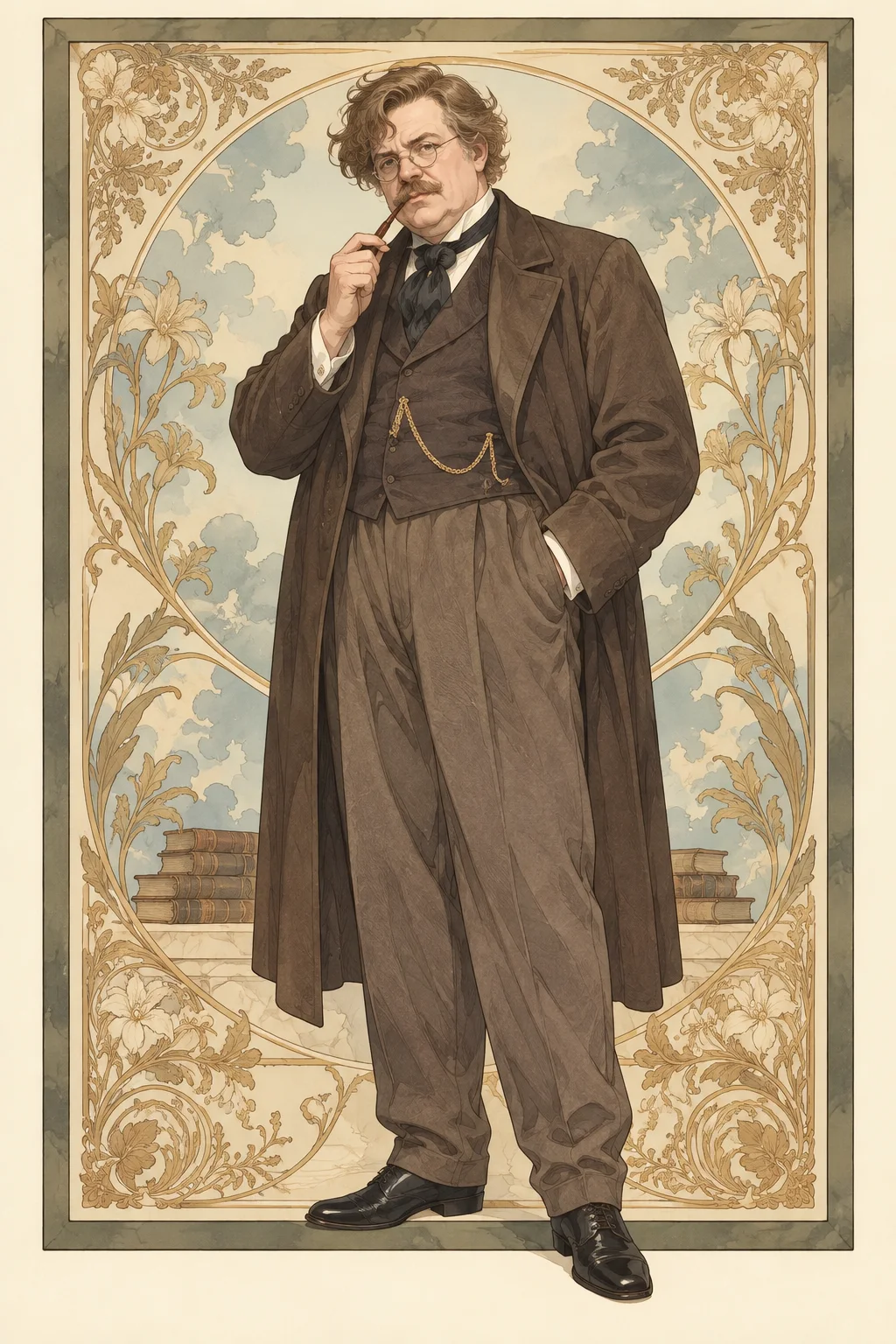
G. K. Chesterton
IEE-D "広告家" Author & Poet · Britain · 19–20cBritish author, poet, and thinker (1874–1936). Known for the Father Brown detective series and philosophical essays "Orthodoxy" and "Heretics." Converted to Catholicism. Called "the Prince of Paradox" and "the Apostle of Common Sense." Friend and debate partner of Shaw and Wells.
主導機能-Ne-p (Paradox & Insight)
"The Prince of Paradox" — instantly reversing commonplace words to expose the blind spots of institutions and social conventions. "The thief respects property — his own" — the core of -Ne-p action.
創造機能+Fi-c (Influence & Motivation)
The young philosopher C.S. Lewis read "Orthodoxy" and converted to Christian faith — Chesterton's +Fi-c creative function pulled the trigger. Moving diverse readers through each person's own deep questions.
脆弱機能1-Ti-p weak (Structure & Truth)
No university education; thinking through metaphor and paradox rather than systematic logic. "Pure reason has its limits; one understands sanity's essence by understanding nonsense" — demonstration rather than proof — evidence of -Ti-p weak.
脆弱機能2+Se-c weak (Reality & Common Sense)
"Am in Market Harborough. Where ought I to be?" — the legendary telegram to his wife Frances captures a lifelong inability to maintain a practical sense of everyday location — evidence of +Se-c weak.
クアドラ・気質・クラブ
クアドラ: Delta Quadra (Tradition) — "human beings are like weeds — they grow anywhere" — an optimistic view of humanity, with consistent focus on the English traditional village, pub, and craftsmanship.
気質: A flexible and jovial debater who maintained friendship even with fierce opponents like Shaw and Wells — the embodiment of the Flexible-Maneuvering temperament.
クラブ: Humanitarian-Artistic Club activity through literature, art, and education. All of Chesterton's works functioned as the integration of artistic completeness and humanitarian mission.
世界観・変化への態度
The world is simple and inherently dangerous (negativism). Vigilance toward threats and realistic exercise of force as the premise of action. "The greatest miracle is in the ordinary person and the everyday" — optimistic sacramentalism. Belief that the sacred was concealed in the most mundane and that Christian orthodoxy was the most surprising and liberating of all worldviews.
変化への態度: Not seeking to transform the current order himself, but waiting for the times to change. "Orthodoxy" and the Father Brown series as the direction of change — the recovery of wonder and common sense as the vehicle of cultural renewal.
