
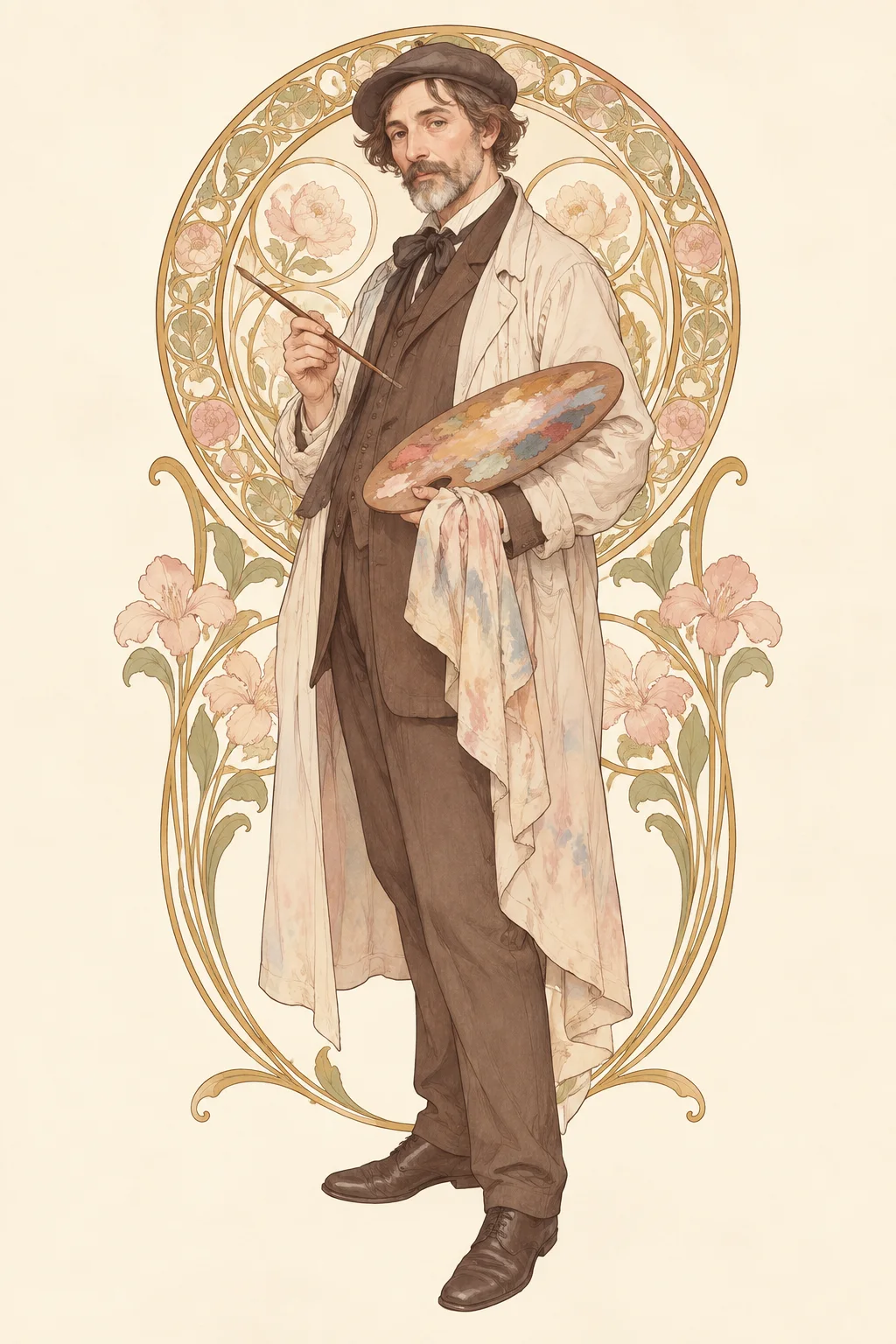
Pierre-Auguste Renoir
SEI-Q "表現者" Painter · French · 19th–20th c.French painter (1841–1919). A master of Impressionism who warmly depicted human joy in "Bal du moulin de la Galette." Even in his final years with arthritic hands so deformed the brush had to be tied to them, he continued to paint. The supreme painter of sensory pleasure and human warmth.
主導機能-Si-p (Sensibility & Subtlety)
To capture subtle differences in light on the dancers in "Bal du moulin de la Galette," he went to the same place repeatedly. Even in later years with deformed arthritic fingers, he had the brush tied to his hand.
創造機能+Fe-c (Elation & Revelation)
During the 1876 work, when a light condition perfectly clicked into place, he trembled with excitement saying "this light will never come again." The spontaneous elation of touching beauty as the fingerprint of all his works.
脆弱機能1-Te-p weak (Optimization & Ingenuity)
Weak -Te-p: organising gatherings at the Café Guerbois while leaving fee management to comrades. Struggling to buy paint money in his youth — friends managing meals for him.
脆弱機能2+Ni-c weak (Future & Challenge)
Weak +Ni-c: never thinking of long-range contracts with galleries throughout his career — moving with present-orientation of "paint what I want when I want."
クアドラ・気質・クラブ
クアドラ: Anti-Gamma Quadra (Utopia) — living through the Paris Commune as γ violence, Renoir continued to paint "dance, food, light, women" as the celebration of the everyday.
気質: Receptive-Adaptive temperament: Franco-Prussian War service, poverty, rheumatoid arthritis — continuing "painting today" through all changes.
クラブ: Socialite Club: building deep human relationships with local people, models, and café regulars wherever he moved. "All my painting models are friends."
世界観・変化への態度
"The suffering and class violence of the present world exist" — the direct statement of present reality. The "absent reality" (joy already restored) is not proclaimed.
変化への態度: Functioning as a symbol of hope for the Impressionist transformation — repeatedly rejected by the Salon as "the waiting" posture.
