
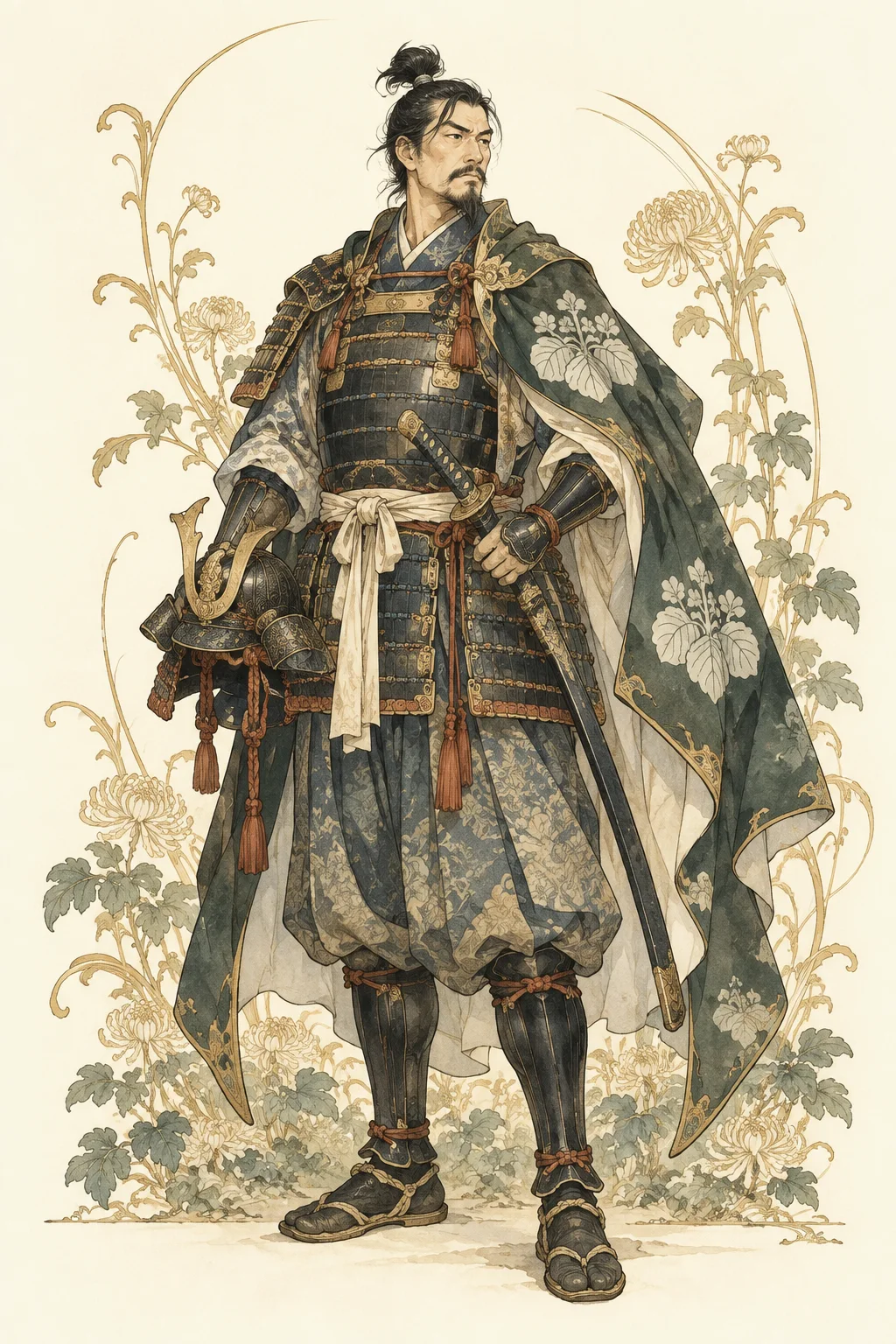
Kusunoki Masashige
ESI-D "Guardian" Warrior · Japanese · 13th–14th c.Warrior of the Nanbokuchō period (1294–1336). He responded to Emperor Go-Daigo's plan to overthrow the shogunate and harassed a shogunal army many times his size through guerrilla tactics. After the collapse of the Kenmu Restoration, he continued fighting for the Southern Court and died at the Battle of Minatogawa. A model of samurai loyalty venerated as a god of war, his Chihaya Castle defence is studied as a military classic.
Leading Function+Fi-p (Morality & Duty)
Personal loyalty to Emperor Go-Daigo as the principle of action — not rescinding the oath at Kasagi and joining a battle known to be lost after two strategic proposals were rejected: the core of +Fi-p action. Fighting to the last at the Battle of Minatogawa.
Creative Function-Se-c (Discipline & Order)
Straw men, rolling boulders, boiling water, torches, faking suicide — directly utilising the sensory resources of the battlefield through unorthodox tactics: the core of -Se-c action. Exploiting the concrete physical environment of Chihaya Castle rather than deploying abstract military theory.
Vulnerable Function 1+Ne-p weak (Creation & Innovation)
Weak +Ne-p (Creation & Innovation): unable to comprehend Emperor Go-Daigo's innovative Alpha-style politics (the Kenmu Restoration) — proposing reconciliation with Ashikaga Takauji instead. Operating by concrete personal loyalty rather than structural understanding of the emperor's revolutionary vision.
Vulnerable Function 2-Ti-c weak (System & Transformation)
Weak -Ti-c (System & Transformation): the pattern of fighting by on-the-spot sensory improvisation rather than systematic deployment of military texts. Concrete field improvisation at Chihaya Castle rather than systematic application of Yamaga Sokō's military theory.
Quadra / Temperament / Club
Quadra: Anti-Alpha Quadra (Meritocracy) — prioritising personal loyalty to the emperor, local networks, and the concrete personal-relationship logic of the warrior class.
Temperament: Balanced-Stable temperament: described as "gentle, earnest, and deep-sighted" — the emotional calm of building large burial mounds for enemy dead. No emotional explosion through the siege of Chihaya or the defeat at Minatogawa.
Club: Socialite Club: the personal networks of local landowners and farmers — with local farmers secretly providing food — as the social foundation.
Worldview & Attitude
Trust in absolute loyalty to Emperor Go-Daigo as the reliable order. The conviction that concrete personal obligation to one's lord is the highest value.
Attitude toward Change: Participating in the inevitably losing battle of Minatogawa as a realistic planned commitment — losing for the sake of loyalty.
