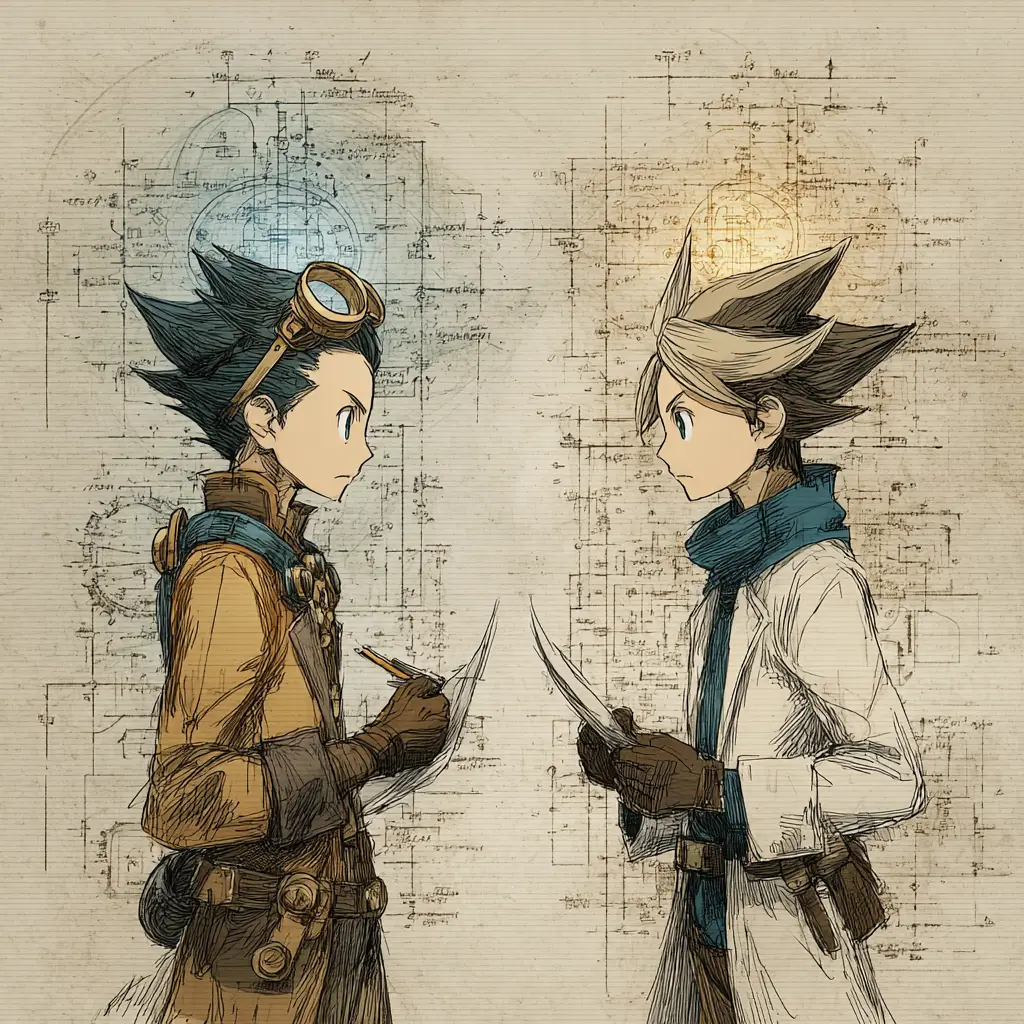
Correction
Correction relationship
Strengths
Promotion of constructive self-correction · Gentle friction · Depth of insight
Weaknesses
Sharpening into critique under obligatory evaluation · Antagonism with persona stability
In the Correction relationship, the partner's presence induces the psychological state of "cognitive dissonance, constructive self-criticism, receptivity to pointers".
Contact occurs at the Balance position of the Learning block — the state (Value 0.50) where intellectual strength is most indirectly mediated and transformed.Unlike Mirror (core, direct intellectual resonance), this relationship naturally produces gentle friction: "this is a little different · I'm becoming aware of a contradiction in myself".
As a mechanism of dual coupling, stimulation of Learning · Balance (Value 0.50) couples with Activation · Balance (Value 0.50, peak experience, transcendence, self-actualization drive).Critical introspection and self-confrontation (Learning · Balance) function as the prior stage of peak experience and transcendence (Activation · Balance) in a sequential coupling — in this relationship, higher-order fulfillment and transcendence tend to come after "awareness · correction" in temporal sequence (Maslow).
As a mechanism of conflict function, fulfilling Learning · Balance gently suppresses Role · Balance (intellectualization, persona stabilization, Value 0.50).Facing internal contradictions (cognitive dissonance) shakes surface stability (persona) (Jung).
Key Points
- 01 The partner's presence induces cognitive dissonance, constructive self-criticism, and receptivity to pointers — gentle friction of "this is a little different"
- 02 Sequential coupling from Learning · Balance (weak) to Activation · Balance (strong): critical introspection → peak experience/transcendence (Maslow)
- 03 Gentle suppression of the conflict function (Role · Balance): facing internal contradictions shakes persona stability (Jung)
- 04 Difference from Mirror (core, direct resonance): this is characterized by gentle friction and constructive pointers
- 05 When persona is stable, constructive criticism/introspection is unlikely to occur
⚠️ Cautions for Good Relationships
The Correction relationship produces gentle friction and constructive pointers naturally, and functions very well in introspection, learning, and self-improvement contexts. But when brought into contexts that obligate formal evaluation, assessment, or feedback — performance reviews, examinations, critiques — gentle friction is easily received as sharp criticism, and pressure on persona stability rises. Also, long-term close contact accumulates the chronic tension "I'm always being pointed out" and the relationship becomes exhausting.
🔧 Improvements for Bad Relationships
When persona stability has fixed and constructive pointers no longer land, it is effective to set up contexts where both can engage in "unfinished · in-progress · experimental" states — prototyping, sharing drafts, venues for trial and error. In settings where involvement with the creative process is structurally embedded rather than evaluation of finished products, cognitive dissonance is naturally accepted and the relationship reactivates.
🔄 Reversal Conditions
Good → Bad
Shift to contexts obligating formal evaluation/assessment/critique · long-term close contact accumulating chronic tension · one partner placed in a power position
Bad → Good
When contexts of unfinished/in-progress/experimental engagement emerge · when venues with structural involvement in the creative process are set · when both explicitly recognize this as "a mutual-pointer relationship"
✅ Conscious Improvement
- Build the habit of receiving pointers as "constructive friction" rather than "criticism"
- Narrow context to sharing creative process and trial-and-error rather than evaluation of finished products
- When "always being pointed out" appears, propose switching context
- Be aware of the desire to stabilize the persona; consciously create "spaces of being unfinished"
Early
Early: Gentle friction and constructive pointers arise naturally
Middle
Middle: Mutual introspection deepens and stabilizes as a correction relationship
Long-term
Long-term: Risk of gentle friction transforming into sharp criticism once evaluation or obligation enters
Long-term Risks
- Exhaustion from sharpening into critique under obligatory evaluation contexts
- Fixation of the chronic tension "I'll be pointed out again"
- Halting of introspection through attachment to persona stability
⚠️ Warning Signs
- Gentle pointers have turned into sharp critique
- The tension "this person will say something again" has settled in
- Introspection and insight rarely arise
Dialogue Style Characteristics
- Gentle pointers like "the only thing that bothers me is" or "I feel a bit differently" come out naturally
- Sharp awareness of subtle misalignments in each other's statements
- A conversational style in which constructive friction arises naturally
⚠️ Typical Misunderstandings
- Accumulated gentle pointers can produce the feeling "I'm always being denied"
- The constructive intent fails to come across and pointers are misread as attack
👥 Role in the Team
Plays a quality-raising role by promoting constructive pointers, correction, and introspection. Produces interaction that refines each other's thinking.
📋 Project Suitability
High suitability for quality improvement, retrospective, and introspective-type projects. Functions especially well in exploration/experiment phases without obligatory evaluation.
🏢 Hiring / HR Considerations
Placement in obligatory evaluation/assessment positions risks sharpening into critique. Placement in growth-oriented contexts is important.
Impact on Mental Health
Promotion of constructive self-criticism and introspection contributes to long-term self-growth and cognitive refinement. Only obligatory evaluation contexts have negative influence.
Growth Potential
High contribution to resolution of cognitive dissonance, self-correction, and deepened introspection. Deep self-growth through critical introspection is naturally promoted.
Qualitative Exhaustion Level
Low (usual) to medium (under obligatory evaluation contexts)
What is a Third Party Type?
Third party types are those who, by intervening as a "third presence" in this two-type relationship, can ease tension or elicit psychological fulfillment. This section shows which third party types are particularly effective for this pairing, based on how they relate to A and B respectively.
Deeply fulfills ILE-Q while giving ESI-Q a transcendent sense of fulfillment.
Ignites ILE-Q's energy while giving ESI-Q a sense of direction and meaning.
※ The following description is written from the perspective of the base type "ILE-Q (Explorer)"
The Correction pair (ILE-Q + ESI-Q) is one where gentle friction and constructive pointers arise naturally, and its introspective depth stabilizes further when third parties join. SEI-D deeply fulfills ILE-Q's cravings (Duality) while giving ESI-Q a higher-order sense of fulfillment (Transcendence). ESE-D ignites ILE-Q's energy (Activation) while providing ESI-Q with direction and sense of meaning (Compass). SEI-D and ESE-D are themselves in a Mirror relationship — when the four are together, fulfillment, ignition, transcendence, and direction are organically linked in a stable quadratic structure.
Function-Block Analysis (Model K)
Maps each type's leading-core (pos 1) program+creative pair to the block and position where it lives in the other type, based on the Model K layout used on the blocks page.
LIE-D 's Leading-Core pair → SEI-D 's block
SEI-D 's Leading-Core pair → LIE-D 's block
Correction — Actual Combinations
Type pairs that fall under this relationship (total 16 pairs). Click to reflect in the checker.


Check this relationship in practice
Select two types to see which relationship type applies
Psychological Foundations
Related Psychological Theories
Theories related to the psychological states likely to arise in this relationship. Learn more on each theory's explanation page.
※ Compatibility data is described using ILE-Q (Explorer) as the base type