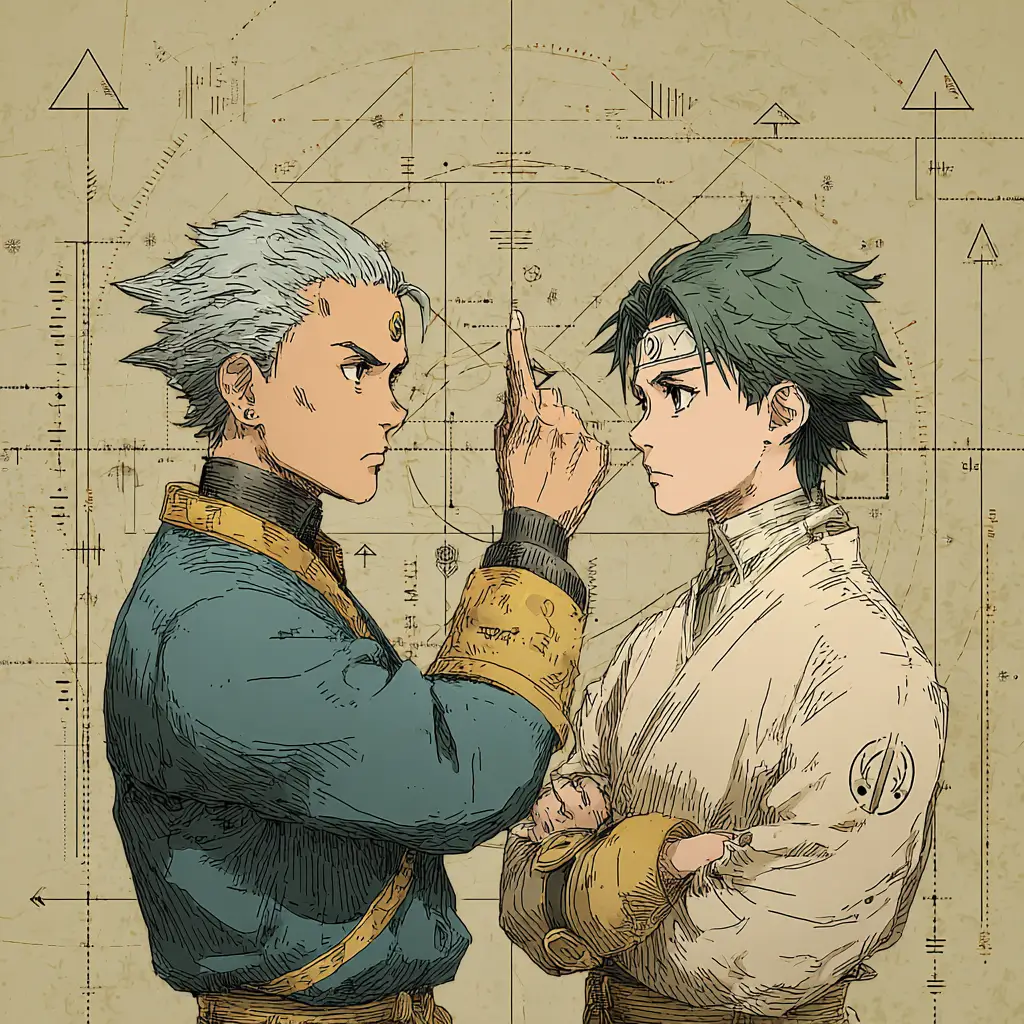
Disciple
Disciple relationship
Strengths
Acceptance of disciple-like learning · Promotion of growth · Benefactor-like fulfillment
Weaknesses
Emergence of approval anxiety · Risk of fixation as "the perpetual disciple" · Stiffening in evaluation scenes
In the Disciple relationship, the partner's presence induces the psychological state of "resilience, disciple-like learning, intellectual receptivity".
The state of the Learning block with the receptive switch on — intellectual strengths are preserved while judgmental input transforms toward the shadow direction (1D) — appears as the experience of "being opened to intellectual stimulation you cannot help but receive".Unlike Mirror (core, mutual intellectual resonance), this relationship tends to produce an asymmetric bond of "passive learning triggered at weak points".
As a mechanism of dual coupling, stimulation of Learning · Adjustment (1D/3D, strong, Value 0.75) couples with Activation · Adjustment (4D/2D, weak, peak experience [beneficiary-type], fulfillment, Value 0.75).Growing while receiving support (Learning · Adjustment) and the experience of fulfillment/benefit (Activation · Adjustment) are coupled — the deeper the disciple-like reception, the more a benefactor-like sense of fulfillment is induced (Bowlby).
As a mechanism of conflict function, fulfilling Learning · Adjustment suppresses Role · Adjustment (procrastination, anxious approval-seeking, Value 0.25).The sense of "I'm receiving · I'm learning" eases approval anxiety (SDT).
Key Points
- 01 The partner's presence induces resilience, disciple-like learning, and intellectual receptivity — opening to intellectual stimulation you cannot help but receive
- 02 Fulfilling Learning · Adjustment (strong) couples with Activation · Adjustment (weak): disciple-learning → benefactor-like fulfillment (Bowlby)
- 03 Suppression of the conflict function (Role · Adjustment): the sense of "I'm receiving" eases approval anxiety and procrastination (SDT)
- 04 Difference from Mirror (core, mutual resonance): this is an asymmetric, passively-triggered learning relationship
- 05 When approval anxiety comes to the fore, learning reception is blocked and quality drops
⚠️ Cautions for Good Relationships
The Disciple relationship is one of "being opened to intellectual stimulation you cannot help but receive", and functions very well in learning and growth contexts. But in contexts where the partner is explicitly placed in "teacher" status — classes, training, coaching contracts — passive learning is easily polluted by obligation and approval anxiety comes to the fore. Also, in contexts with evaluation or assessment in the same field, "disciple-like openness" can turn into defensive rigidity. When "staying a disciple" chronifies long-term, the felt sense of growth is lost and the relationship stagnates.
🔧 Improvements for Bad Relationships
When approval anxiety and rigidity come to the fore, it is effective to separately set up contexts where you can be the "giving / teaching side". Deliberately combining disciple-like receiving and mentor-like giving structurally eases approval anxiety within the relationship. Also, mechanisms that visualize "growth realization" — outputs, records, accumulated feedback — become entries for reactivation.
🔄 Reversal Conditions
Good → Bad
Shift to contexts involving evaluation or assessment · emergence of competition in the same field · prolonged fixation as "perpetual disciple" · partner explicitly placed in an "obligation to teach" position
Bad → Good
When separate contexts for being the "giving side" emerge · when mechanisms for visualizing growth-realization are set · when pure exploratory learning detached from evaluation is possible
✅ Conscious Improvement
- Be aware of the "I want approval" feeling and direct attention to receiving itself rather than to approval
- Deliberately secure separate contexts where you can give or transmit
- Build mechanisms to periodically visualize and accumulate growth-realization
- Consciously separate evaluation/assessment settings from pure learning settings
Early
Early: Opening to intellectual stimulation you cannot help but receive begins
Middle
Middle: Disciple-learning deepens and resilience and growth-reception settle in
Long-term
Long-term: If "perpetual disciple" fixes, risks of stagnation of growth and chronic approval anxiety arise
Long-term Risks
- Loss of growth realization through fixation of the disciple position
- Decline of autonomy through chronic approval anxiety
- Pollution of learning through obligatory evaluation
⚠️ Warning Signs
- The feeling of growing has vanished
- You obsess over evaluation or approval from the partner
- The learning space has been polluted by obligation or evaluation
Dialogue Style Characteristics
- A conversational style of receiving intellectual stimulation and responding introspectively
- Many "I see" and "I hadn't noticed" words of reception
- Centered on receiving and deepening reflection rather than answering questions
⚠️ Typical Misunderstandings
- Disciple-like reception is misread as "dependence"
- Introspective responses are misread as "having no opinions of one's own"
- Seeking approval creates an impression of "lacking confidence"
👥 Role in the Team
Functions well as a pair for intellectual growth and learning promotion. Resilience and growth-reception are naturally facilitated.
📋 Project Suitability
High suitability for projects where learning and growth matter. Shines in contexts demanding knowledge reception and integration.
🏢 Hiring / HR Considerations
In settings involving evaluation or judgment, approval anxiety easily comes to the fore. Designing mechanisms that visualize growth-realization is important.
Impact on Mental Health
Disciple-learning and growth-reception strengthen resilience and self-efficacy long-term. Chronic approval anxiety is the only negative influence.
Growth Potential
High contribution to resilience, intellectual receptivity, and growth-reception. Deep learning and integration through receiving are promoted.
Qualitative Exhaustion Level
Low (usual) to medium (when approval anxiety chronifies)
What is a Third Party Type?
Third party types are those who, by intervening as a "third presence" in this two-type relationship, can ease tension or elicit psychological fulfillment. This section shows which third party types are particularly effective for this pairing, based on how they relate to A and B respectively.
Deeply fulfills ILE-Q while drawing out EII-Q's benefactor-like activation.
Ignites ILE-Q's energy while giving EII-Q warm resonance.
※ The following description is written from the perspective of the base type "ILE-Q (Seeker)"
The Disciple pair (ILE-Q + EII-Q) is a relationship of "being opened to intellectual stimulation you cannot help but receive", and its asymmetric learning becomes more stable when a third party joins. SEI-D deeply fulfills ILE-Q's cravings (Duality) while drawing out EII-Q's benefactor-like activation (Benefactor). ESE-D ignites ILE-Q's energy (Activation) while giving EII-Q warm trust and empathy (Resonance). SEI-D and ESE-D are themselves in a Mirror relationship — when the four are together, fulfillment, ignition, resonance, and benefaction are organically linked in a stable quadratic structure.
Function-Block Analysis (Model K)
Maps each type's leading-core (pos 1) program+creative pair to the block and position where it lives in the other type, based on the Model K layout used on the blocks page.
Disciple — Actual Combinations
Type pairs that fall under this relationship (total 32 pairs). Click to reflect in the checker.
相手が教え、自分が学ぶ(鏡像)
































































Check this relationship in practice
Select two types to see which relationship type applies
Psychological Foundations
Related Psychological Theories
Theories related to the psychological states likely to arise in this relationship. Learn more on each theory's explanation page.
This Pair
Read the compatibility of just the two of you
The general picture ends here. A one-to-one reading with a real person draws on both of your answer data to show which functions resonate and where friction tends to arise.
※ Compatibility data is described using ILE-Q (Seeker) as the base type