
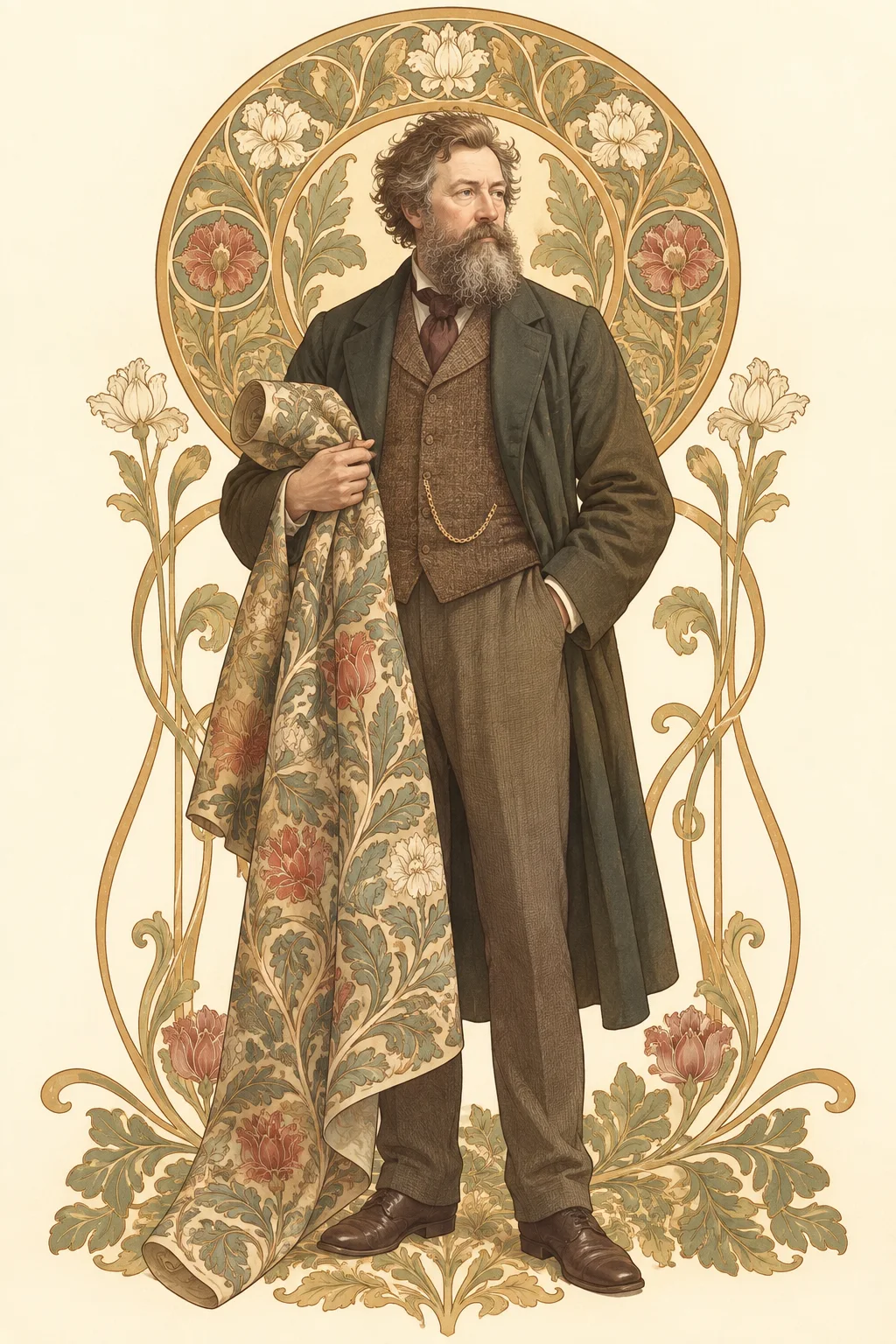
William Morris
ESE-Q "Harmonizer" Designer / Socialist · British · 19th c.British artist, designer, and socialist (1834–1896). Criticising the degradation of crafts under the Industrial Revolution, he advocated for beautiful handmade everyday objects. His wallpaper and textile designs remain in production today. The foundational figure for every subsequent design-reform movement.
Leading Function+Fe-p(使命と威光)
"Factory production kills the human soul" — emotional speeches at workers' meetings. Organising the Socialist League and street declarations against industrial capitalism.
Creative Function-Si-c(緩和と解消)
The Arts and Crafts movement centred on -Si-c — "Rejecting mechanical-industrial contamination and creating beautiful, simple handcraft spaces." Physiological aversion to factory ugliness.
Vulnerable Function 1+Ni-p弱(予測と進化)
Weak +Ni-p: the consistent pattern of concentration on the present emotional mission pushing long-range trend reading to the background.
Vulnerable Function 2-Te-c弱(応用と実験)
Weak -Te-c: documented difficulty with practical knowledge accumulation — financial confusion in Morris & Co., difficulty with production management at Kelmscott Press.
Quadra / Temperament / Club
Quadra: Anti-Gamma Quadra (Utopia) — "Capitalist industrial production destroys beauty" — total confrontation with γ accumulation and efficiency doctrine.
Temperament: Linear-Assertive temperament: declaring opposition to industrial revolution evil through the practical advance of founding Kelmscott Press.
Club: Socialite Club: transmitting the mission of counter-culture against industrial civilisation through personal connections with artists and the Socialist League.
Worldview & Attitude
"The ugliness and dehumanisation of industrial production exist" — the direct statement of present reality. The ないもの (a world of beauty already restored) is not proclaimed.
Attitude toward Change: Executing the Arts and Crafts movement as a realistic transformation plan — a practitioner of failure-resistant aesthetic reform.
