
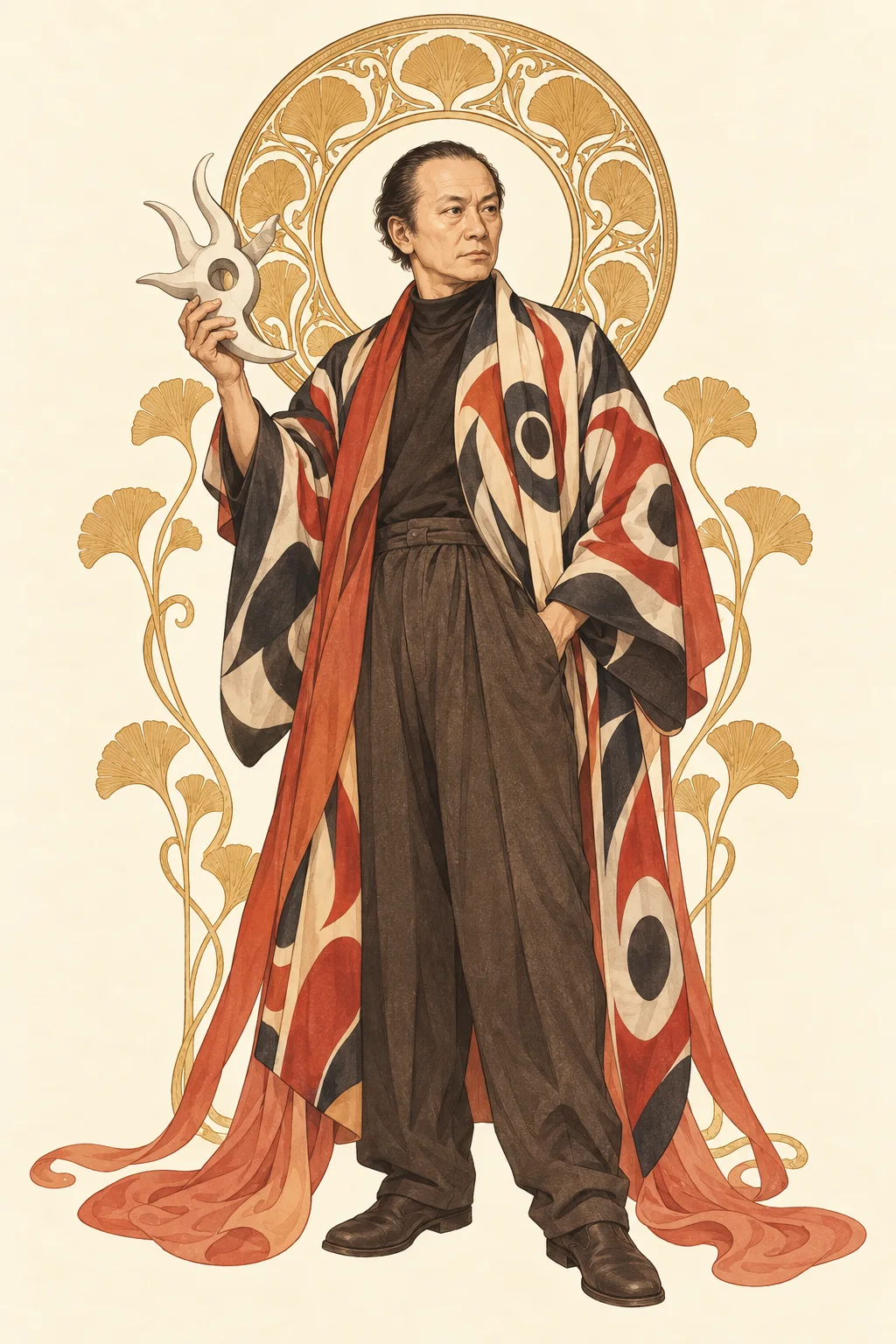
Tarō Okamoto
ESE-Q "Harmonizer" Artist · Japanese · 20th c.Japanese artist (1911–1996). With "Art is an explosion" and the Tower of the Sun at the 1970 Osaka World Expo, he rooted avant-garde art in Japan. Consistently confronted commercialism; refused the Order of Culture. One of the most uncompromising artist-rebels in Japanese cultural history.
Leading Function+Fe-p(使命と威光)
"Art is an explosion" — publicly throwing anger on television. Publicly refusing the Order of Culture as a direct challenge to the establishment. "Don't paint paintings that sell."
Creative Function-Si-c(緩和と解消)
Aversion to "commercially polished beauty" — rejection of commercially refined space as the core of creation. The "explosive" aesthetic of his studio maintaining -Si-c order beneath apparent chaos.
Vulnerable Function 1+Ni-p弱(予測と進化)
Weak +Ni-p: the consistent pattern of concentration on the present emotional mission pushing long-range trend reading to the background.
Vulnerable Function 2-Te-c弱(応用と実験)
Weak -Te-c: fully delegating technical production management of the Tower of the Sun to assistants — emotional artistic mission focus pushing production management to the background.
Quadra / Temperament / Club
Quadra: Anti-Gamma Quadra (Utopia) — "Art that sells is dead" — total rejection of γ commercialism. Refusing the Order of Culture as "γ accumulation of authority."
Temperament: Linear-Assertive temperament: the direct connection from "Art is an explosion" to action.
Club: Socialite Club: standing at the centre of Ginza bars, Tokyo artist community, and Parisian intellectual circles, transmitting the mission of avant-garde art through personal presence.
Worldview & Attitude
"The commercialisation and falsification of art exist" — the direct statement of present reality. The ないもの (a world of pure artistic explosion) is not proclaimed.
Attitude toward Change: Executing the Tower of the Sun as a realistic transformation plan — planting a bomb of avant-garde art within the authority of the World Expo.
