
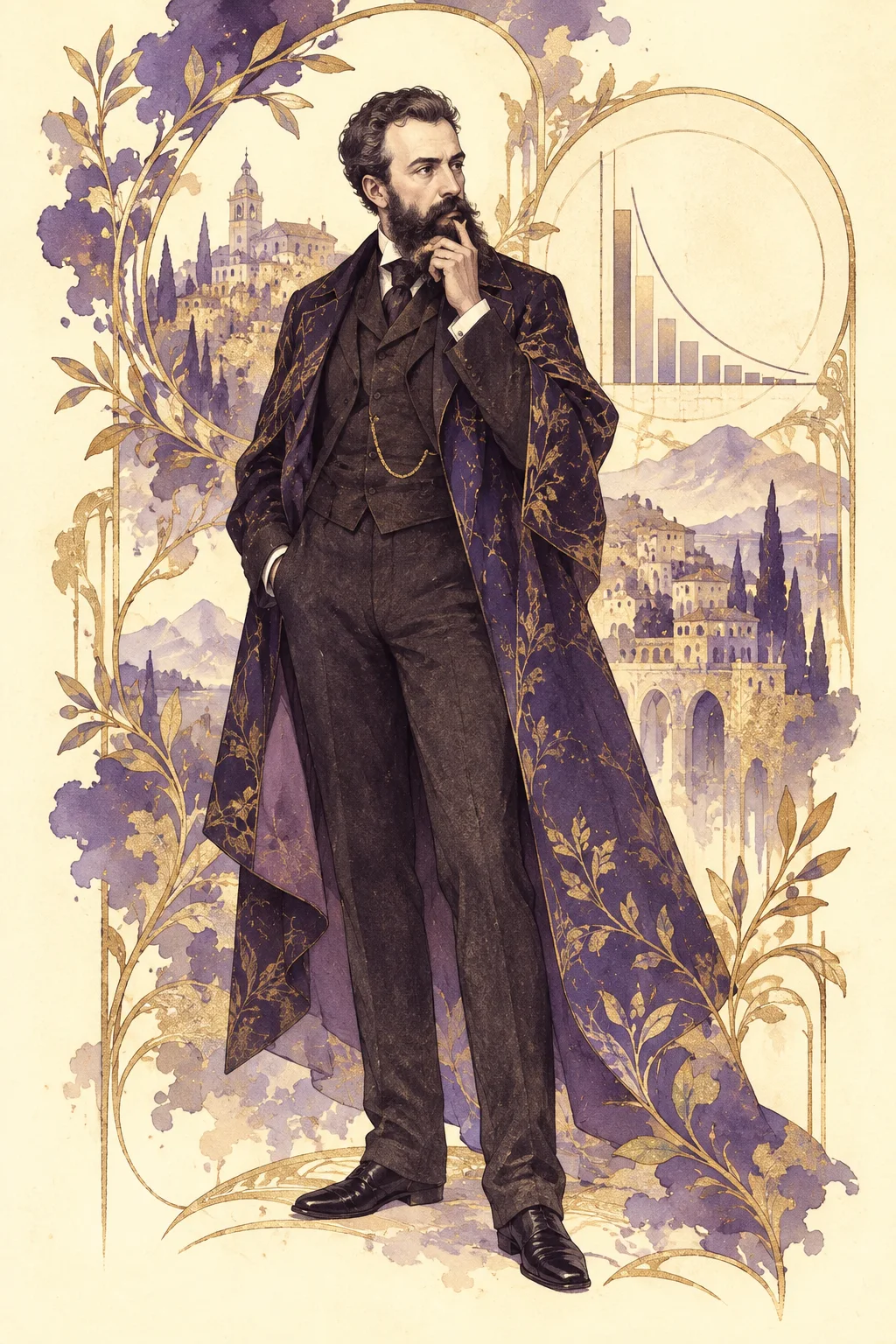
Celebrity Index ILI-Q "Critic" Vilfredo Pareto

Vilfredo Pareto

ILI-Q "Critic" Economist / Sociologist · Italian · 19th–20th c.

Italian economist and sociologist (1848–1923). He made revolutionary contributions to economics and sociology through the "Pareto Principle (80/20 rule)," "Pareto optimality," and "the circulation of elites." His mathematical approach to social science and cold-eyed analysis of power made him a foundational figure of modern social science.

Leading Function-Ni-p (Crisis & Fantasy)

The "circulation of elites" theory — formalising the historical collapse cycle in which ruling classes inevitably corrupt and are replaced by new elites through revolution. Foreseeing the rise of Italian Fascism before World War I.

Creative Function+Te-c (Technology & Accumulation)

Deriving the "Pareto Principle (80/20 rule)" from statistical data. Economic research at the University of Lausanne rigorously grounded in mathematical models and measured data. The 3,000-page Treatise on General Sociology as +Te-c accumulation.

Vulnerable Function 1-Fe-p weak (Inspiration & Motivation)

Weak -Fe-p (Inspiration & Motivation): concentration on academic analysis consistently pushing emotional inspiration to the background.

Vulnerable Function 2+Si-c weak (Diligence & Care)

Weak +Si-c (Diligence & Care): the Pareto optimum concept itself reflecting concentration on efficient equilibrium states rather than personal human warmth.

Quadra / Temperament / Club

Quadra: Anti-Alpha Quadra (Meritocracy) — the discovery of the 80/20 law coldly describing the internal logic of social hierarchy embodies the Anti-Alpha principle.

Temperament: Receptive-Adaptive temperament: maintaining the steady intellectual pace of mathematical sociology through the Italian unification and Fascist rise. Partial support for Mussolini combined with academic detachment.

Club: Researcher Club: connecting economics, sociology, political science, and statistics around the single social theory of "the circulation of elites" — the Researcher Club integration.

Worldview & Attitude

The world is complex and inherently good (positivism). Deep trust in human possibility and social transformation as the premise of action. A direct statement that "the reality of power concentration by 20% and the corruption cycle of elites exists." Affirming only the "present reality" of social structural inequality sensed by -Ni-p — quantified as numerical data — without touching on the "absent reality" of equalisation or improvement. Even Pareto optimality functioned not as "a desirable state" but as a description of "what actually happens."

Attitude toward Change: Presenting the possibility of social-scientific transformation while not directly engaging in political action — pointing the direction.