
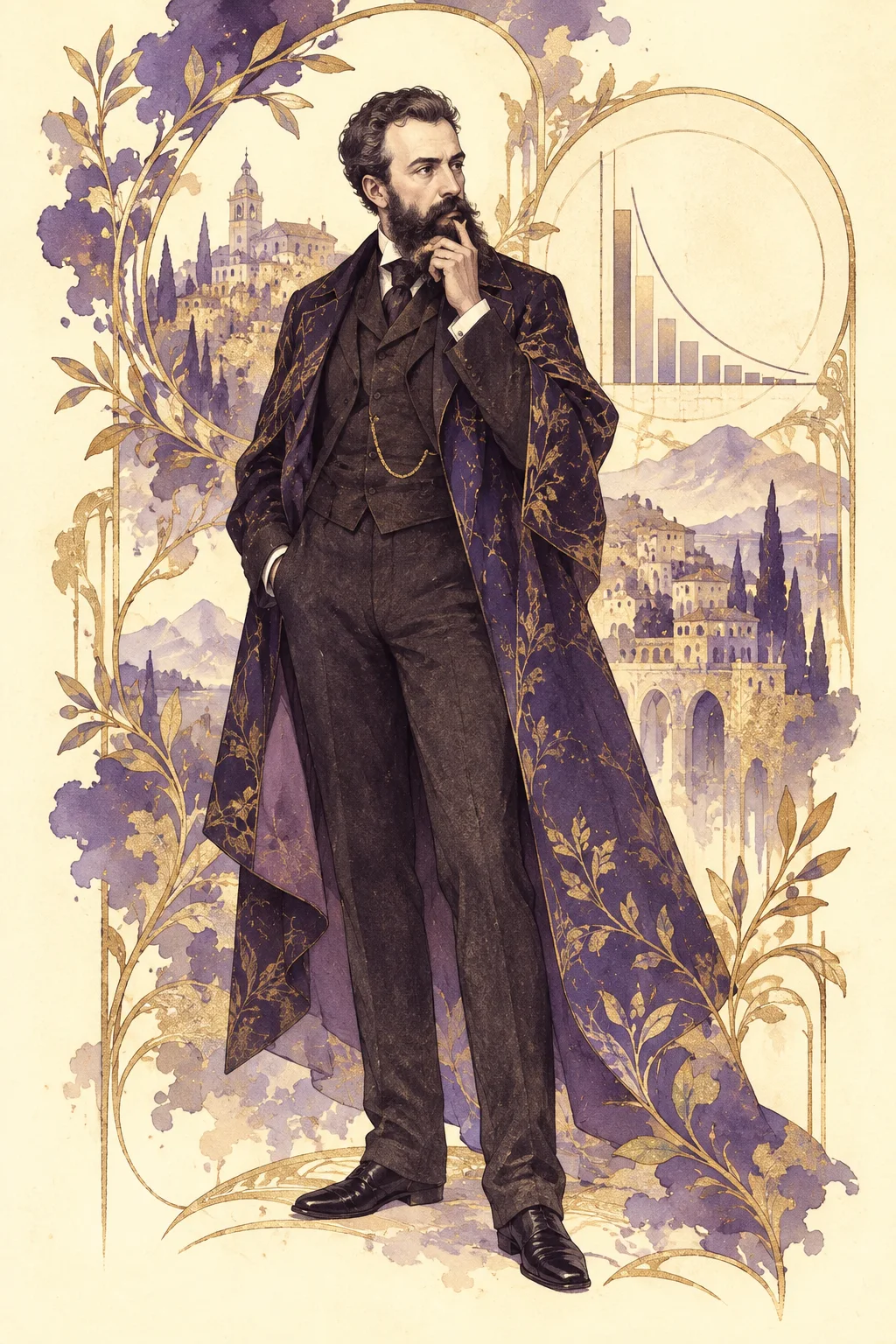
Vilfredo Pareto
ILI-Q "批評家" Economist / Sociologist · Italian · 19th–20th c.Italian economist and sociologist (1848–1923). He made revolutionary contributions to economics and sociology through the "Pareto Principle (80/20 rule)," "Pareto optimality," and "the circulation of elites." His mathematical approach to social science and cold-eyed analysis of power made him a foundational figure of modern social science.
主導機能-Ni-p (Crisis & Fantasy)
The "circulation of elites" theory — formalising the historical collapse cycle in which ruling classes inevitably corrupt and are replaced by new elites through revolution. Foreseeing the rise of Italian Fascism before World War I.
創造機能+Te-c (Technology & Accumulation)
Deriving the "Pareto Principle (80/20 rule)" from statistical data. Economic research at the University of Lausanne rigorously grounded in mathematical models and measured data. The 3,000-page Treatise on General Sociology as +Te-c accumulation.
脆弱機能1-Fe-p weak (Inspiration & Motivation)
Weak -Fe-p (Inspiration & Motivation): concentration on academic analysis consistently pushing emotional inspiration to the background.
脆弱機能2+Si-c weak (Diligence & Care)
Weak +Si-c (Diligence & Care): the Pareto optimum concept itself reflecting concentration on efficient equilibrium states rather than personal human warmth.
クアドラ・気質・クラブ
クアドラ: Anti-Alpha Quadra (Meritocracy) — the discovery of the 80/20 law coldly describing the internal logic of social hierarchy embodies the Anti-Alpha principle.
気質: Receptive-Adaptive temperament: maintaining the steady intellectual pace of mathematical sociology through the Italian unification and Fascist rise. Partial support for Mussolini combined with academic detachment.
クラブ: Researcher Club: connecting economics, sociology, political science, and statistics around the single social theory of "the circulation of elites" — the Researcher Club integration.
世界観・変化への態度
The world is complex and inherently good (positivism). Deep trust in human possibility and social transformation as the premise of action. A direct statement that "the reality of power concentration by 20% and the corruption cycle of elites exists." Affirming only the "present reality" of social structural inequality sensed by -Ni-p — quantified as numerical data — without touching on the "absent reality" of equalisation or improvement. Even Pareto optimality functioned not as "a desirable state" but as a description of "what actually happens."
変化への態度: Presenting the possibility of social-scientific transformation while not directly engaging in political action — pointing the direction.
