
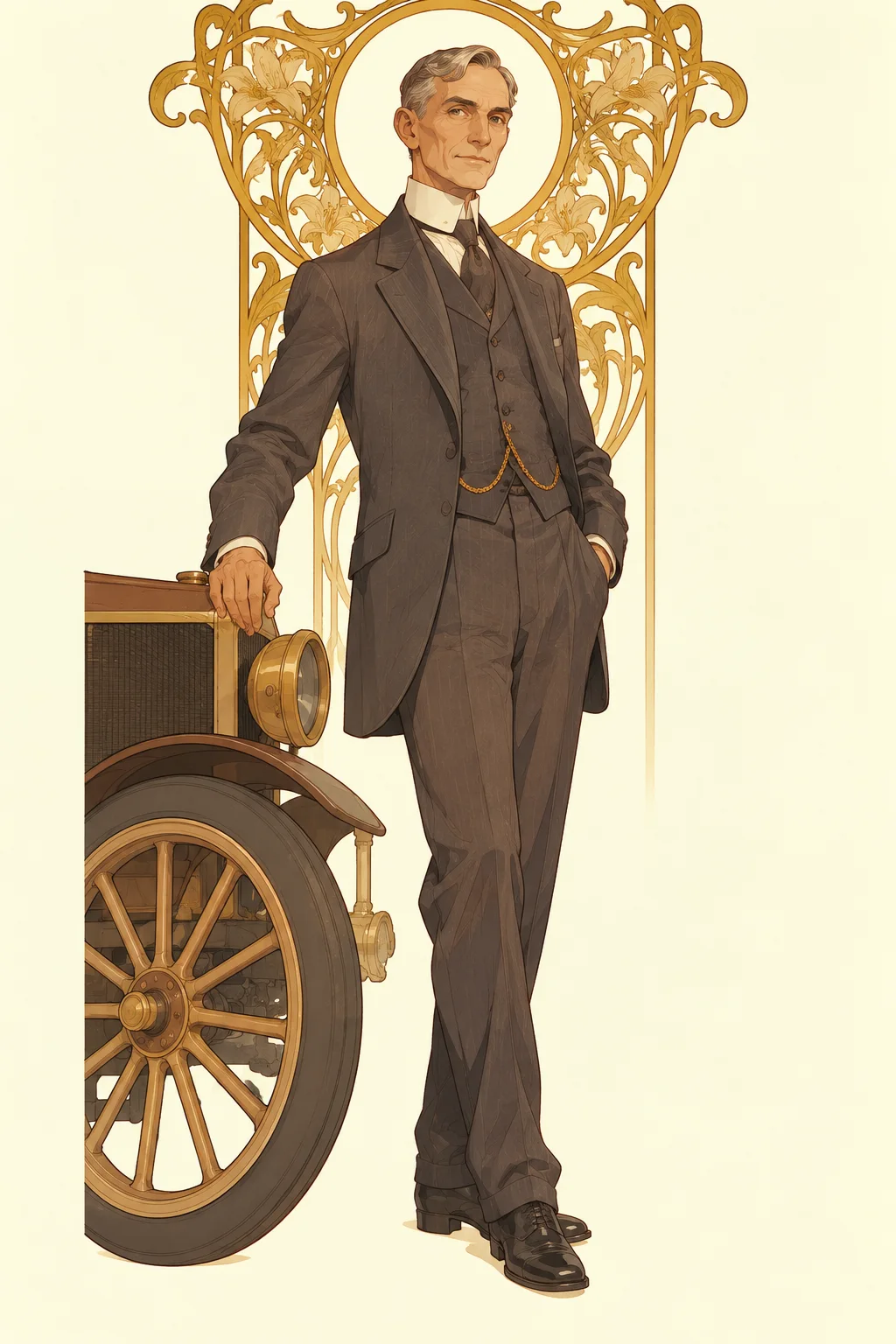
Henry Ford
LSE-D "実務官" Industrialist / Founder · American · 19th–20th c.American auto manufacturer founder (1863–1947). With the Model T (1908) and assembly-line production he brought the automobile to ordinary people — completing the industrial revolution. High wages and low prices as a simultaneous strategy. His anti-Semitism and union-busting are dark chapters. A figure of profound ambiguity: the democratiser of mobility and a deeply flawed human being.
主導機能-Te-p (Optimization & Ingenuity)
Extreme optimisation of production costs through assembly-line work — the core of -Te-p action. Numerical institutional design maintaining profits while lowering the Model T's price annually; resource optimisation through vertical integration.
創造機能+Si-c (Diligence & Care)
Improving workers' wages — the core of +Si-c creative function. The $5-a-day wage — an extraordinary rate at the time — functioning as +Si-c care for workers' living environments.
脆弱機能1-Ni-p weak (Crisis & Fantasy)
Weak -Ni-p: documented difficulty reading long-term threats from unions and social change.
脆弱機能2+Fe-c weak (Elation & Revelation)
Weak +Fe-c: recorded as consistently prioritising practical numerical and results-based management over inspiring speeches and emotional collective inspiration.
クアドラ・気質・クラブ
クアドラ: Anti-Beta Quadra (Civil Society) — fundamental challenge to the authoritative convention of horse-drawn carriages and steam power as the operational principle.
気質: Linear-Assertive temperament: candid, forceful, speaking in numbers. Anti-Semitic statements and union-busting as direct assertion; "proving it in numbers" rather than apology.
クラブ: Pragmatist Club: consistently prioritising practical function and numbers over theory.
世界観・変化への態度
"Mass production can make ordinary people prosperous" — optimistic democratic industrialism.
変化への態度: Executing the Ford system as a realistic transformation plan — a practitioner of failure-resistant staged industrial revolution.
