
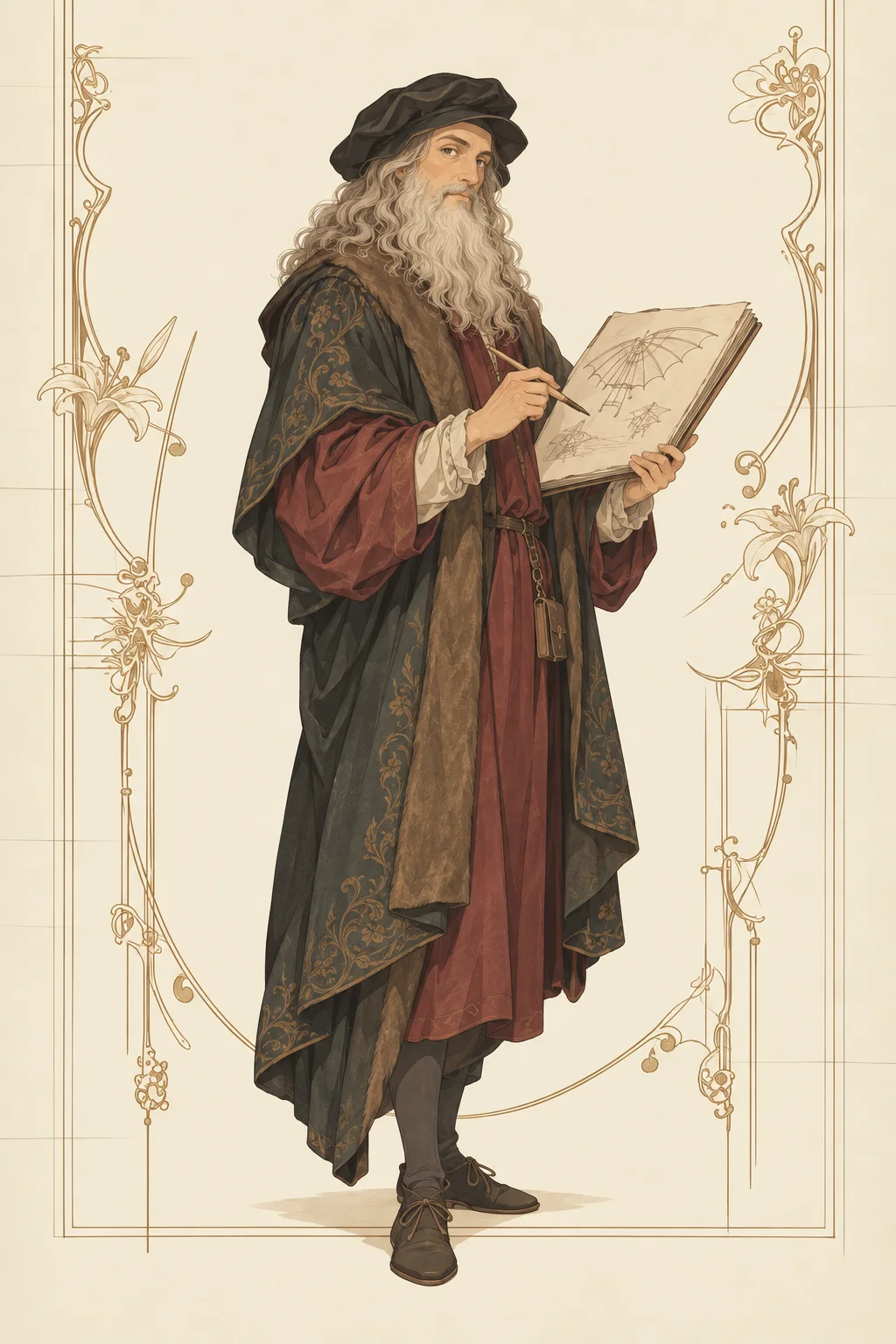
Celebrity Index ILE-Q "Explorer" Leonardo da Vinci

Leonardo da Vinci

ILE-Q "Explorer" Artist / Scientist · Italian · 15th–16th c.

The universal genius of the Renaissance. He left masterpieces including the Mona Lisa and The Last Supper while also bequeathing vast sketches for inventions spanning anatomy, architecture, flying machines, and weapons. An observer who transcended the boundary between science and art, his work continues to be studied to this day — the supreme embodiment of human intellect throughout history.

Leading Function+Ne-p (Creation & Innovation)

Freely connecting painting, sculpture, architecture, anatomy, hydraulics, and flight in expansive, multi-domain exploration — the core of +Ne-p action. Unexpected connections between natural structure and artistic beauty; the innovative combinations of knowledge across entirely different fields.

Creative Function-Ti-c (System & Transformation)

Systematic resolution of the logical structure of nature — the flow of water, the wing of a bird, the mechanics of the body — is the -Ti-c creative function. The Vitruvian Man as a systematic embodiment of the human body and cosmos; detailed anatomical drawings as a systematic logical framework for art.

Vulnerable Function 1+Fi-p weak (Morality & Duty)

Weak +Fi-p (Morality & Duty): recorded failures to honor obligations to patrons and complete commissioned works. The many unfinished pieces — Adoration of the Magi, Saint Jerome — as evidence of difficulty fulfilling artistic obligations. The notebooks record a pattern of perpetual intellectual restlessness overriding commitments.

Vulnerable Function 2-Se-c weak (Discipline & Order)

Weak -Se-c (Discipline & Order): the chaotic organization of notes; continual inattentiveness to systematic work schedules. Over 13,000 pages of notes in no organized order, spread across dozens of notebooks — evidence of fundamental indifference to organizational discipline.

Quadra / Temperament / Club

Quadra: Alpha Quadra (Genesis) — simultaneously exploring anatomy, painting, architecture, music, and hydraulics shows the Alpha spirit of crossing knowledge boundaries with a view open to all. The principle of democratically sharing knowledge governed the entire direction of his work.

Temperament: Flexibly switching between the roles of painter, sculptor, architect, musician, mathematician, geologist, and anatomist according to the context and patron — the Flexible-Maneuvering temperament. Serving Milan's duke, the Pope, and the French king in succession, his role adapted entirely to each context.

Club: Connecting anatomy, optics, fluid dynamics, acoustics, and geology into the unified practice of painting — the Researcher Club at its apex. The 7,000+ pages of notebooks show the pattern of systematic knowledge absorption across domains; the aerial screw and armored vehicle as applications of cross-domain research.

Worldview & Attitude

The world is complex but fundamentally good (positivist). A trust in human potential and transformative capacity. The exploration from anatomy to aircraft design expresses a positive stance: the complexity of the natural world rewards patient observation.

Attitude toward Change: A symbol of hope, pointing directions 500 years ahead of his era while leaving execution to successors. His designs for flying machines and solar power were directional pointers; he made no attempt to implement them institutionally.