
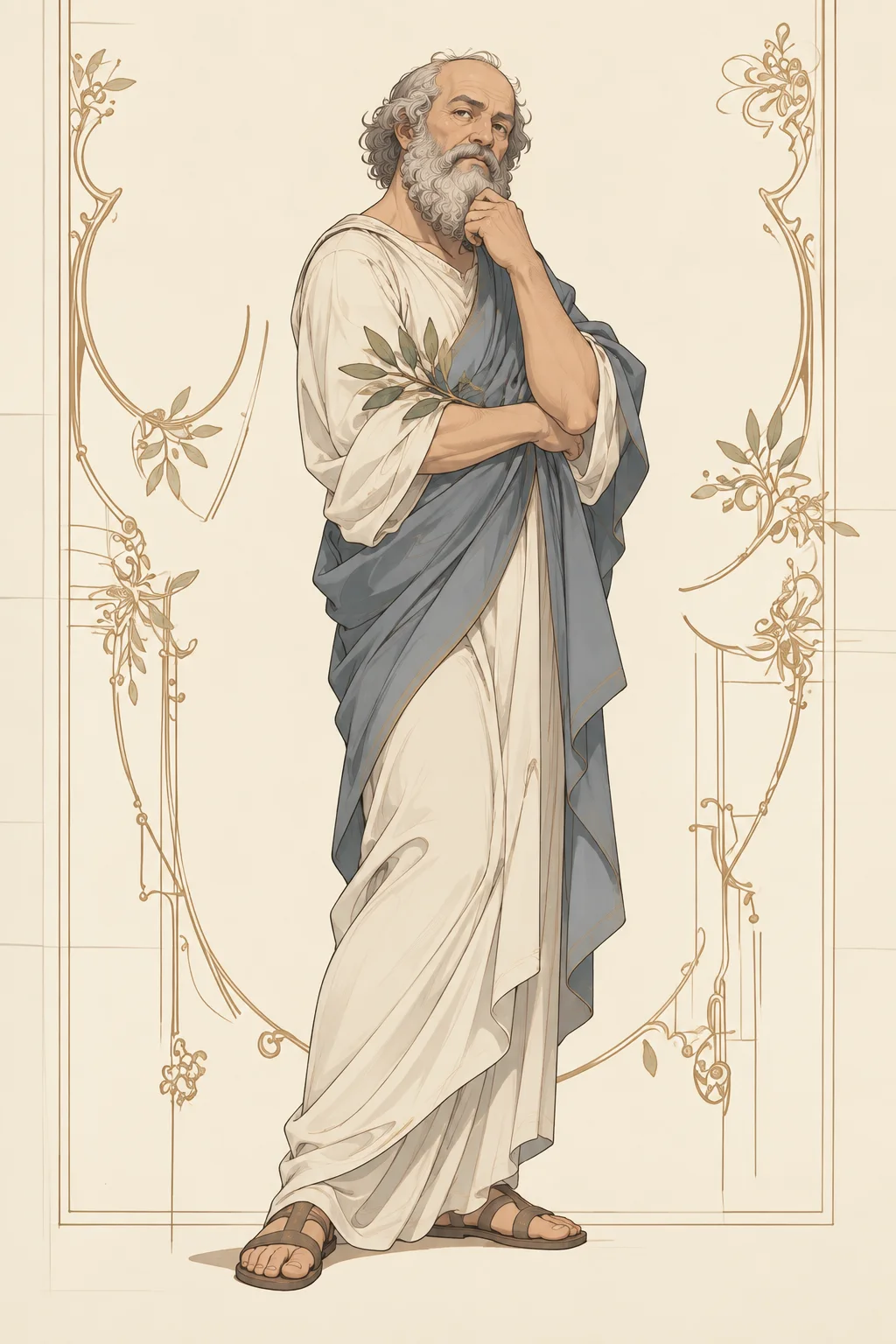
Socrates

ILE-Q "Explorer" Philosopher · Greece · 5th–4th c. BC

Ancient Greek philosopher and founder of the "Socratic method" — pursuing truth through dialogue without leaving written works. He taught "knowing that one knows nothing" and fostered critical thinking, but was condemned to drink hemlock for allegedly corrupting Athenian youth. His thought became the foundation of Western philosophy through Plato, enduring as the ideal image of the philosopher.

Leading Function+Ne-p (Creation & Innovation)

Continually questioning the established intellectual conventions of Athens — the core of +Ne-p action. The maieutic method, drawing new concepts out of the interlocutor's own thinking; the "I know that I know nothing" as the starting point for unending expansive inquiry.

Creative Function-Ti-c (System & Transformation)

Systematic logical resolution of philosophical contradictions — definitions of knowledge, beauty, and justice — is the -Ti-c creative function. Systematic dissolution of contradictions through dialogue; "the unexamined life is not worth living" as logical closure of the need for examination.

Vulnerable Function 1+Fi-p weak (Morality & Duty)

Weak +Fi-p (Morality & Duty): spending virtually all time in dialogue with disciples while barely supporting family finances — recorded in multiple disciples' accounts. Choosing death rather than exile to continue philosophical dialogue shows that abstract principles overrode personal obligations.

Vulnerable Function 2-Se-c weak (Discipline & Order)

Weak -Se-c (Discipline & Order): barefoot, rough garments, indifference to everyday habits — recorded in multiple disciples' testimonies. The chaotic domestic life with Xanthippe; disregard for sensory comfort and bodily care.

Quadra / Temperament / Club

Quadra: Alpha Quadra (Genesis) — the paradoxical starting point of "knowing that one knows nothing," combined with the practice of dialoguing with anyone in the Athenian agora, embodies Alpha Quadra's trust in intellectual exchange. Choosing death rather than exile to preserve philosophical dialogue shows the core principle never wavered.

Temperament: Moving across politicians, soldiers, craftsmen, and philosophers — adapting style completely to each partner's intellectual level and context — is the Flexible-Maneuvering temperament. His method shifted entirely between the formal court and informal street corner, but the core direction of inquiry remained constant.

Club: Systematically connecting philosophy, ethics, political science, aesthetics, and mathematics through the single practice of dialogue — the archetypal Researcher Club. Not leaving written works but embodying practical knowledge through dialogue; the Socratic method as a model of cross-domain knowledge integration.

Worldview & Attitude

The world is complex but fundamentally good (positivist). A foundational trust in human potential. The "unexamined life is not worth living" reflects a humble, positive stance toward complex reality, trusting that it yields to patient inquiry.

Attitude toward Change: Embodies the possibility of transformation, pointing the direction for later generations. Choosing death rather than exile — showing the value of philosophical dialogue to all who came after — was his transformative act, leaving execution to Plato and subsequent generations.