
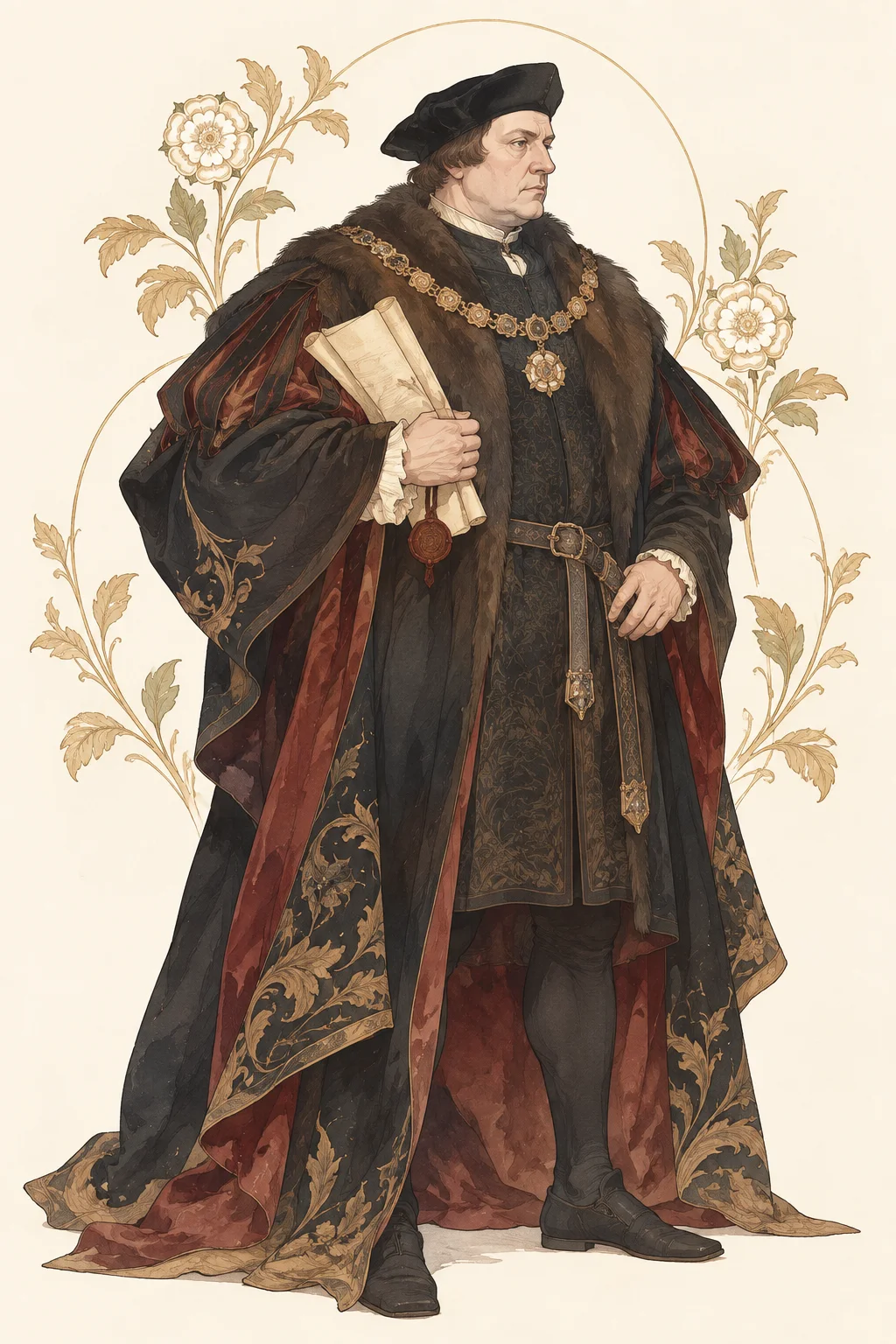
Thomas Cromwell
ILI-D "Strategist" Statesman / Lawyer · British · 15th–16th c.English politician and lawyer (1485–1540). As Henry VIII's Chief Minister he led the establishment of the Church of England's independence, the dissolution of the monasteries, and the establishment of Parliamentary sovereignty — the practical designer of the English Reformation. Immortalised in Hilary Mantel's Wolf Hall trilogy, he is now recognised as one of the most consequential statesmen in English history — and one of the most unjustly executed.
Leading Function+Ni-p (Prediction & Evolution)
Early detection of Henry VIII's Reformation as a historical turning point and moving to execute it — the core of +Ni-p action. Anticipating the establishment of the Church of England as a long-term power structure change; the dissolution of the monasteries as a financial structural reform.
Creative Function-Te-c (Application & Experiment)
Practical analysis and systematisation of political and military situations — the core of -Te-c creative function. Efficient knowledge management through practical intelligence collection, organisation, and utilisation as evidence.
Vulnerable Function 1+Fe-p weak (Mission & Prestige)
Weak +Fe-p: the consistent pattern of long-range prediction focus pushing emotional human connection to the background.
Vulnerable Function 2-Si-c weak (Relief & Resolution)
Weak -Si-c: long-range strategic prediction focus consistently pushing sensory human care to the background.
Quadra / Temperament / Club
Quadra: Gamma Quadra (Market) — pragmatism as efficient practical service to the king in the religious reform power market. The γ judgement of prioritising practical royal service over personal loyalty running through all action.
Temperament: Receptive-Adaptive temperament: switching entirely different roles in response to the situation. Consistently surviving through flexible reception rather than frontal opposition.
Club: Researcher Club: the core of Cromwell's Researcher Club activity was systematically integrating his service under Cardinal Wolsey, self-taught law, and intelligence from the Reformation into the institutional design of the Church of England.
Worldview & Attitude
"Power is held through information and institutional design" — realist conviction. A worldview that sees structural dangers and trusts systematic institutional engineering as the response.
Attitude toward Change: Executing the English Reformation as a realistic transformation plan — the practical designer of an institutional revolution.
