
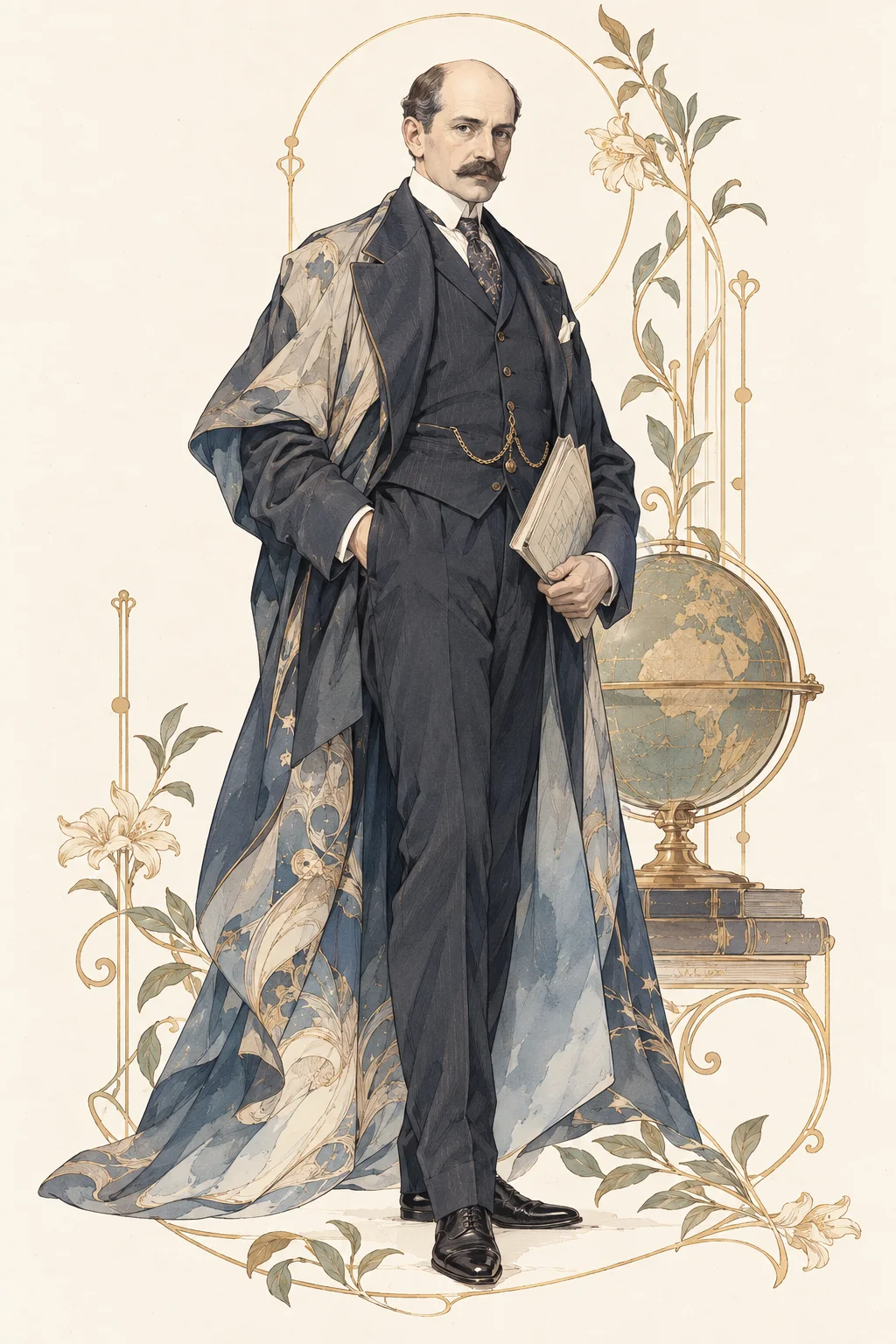
Paul Warburg
ILI-D "Strategist" Banker · German-American · 19th–20th c.German-American banker (1868–1932). Moving from the Hamburg banking family to the United States, he was the primary architect of the Federal Reserve System (1913) following the Jekyll Island conference of 1910. Without the Fed, the repeated financial panics of the 19th century might have continued indefinitely. His warning about the dangers of financial instability proved prescient in the 1929 crash he did not live to fully witness.
Leading Function+Ni-p (Prediction & Evolution)
Long-term observation of the internal contradictions of the US financial system and designing the Federal Reserve as the solution — the core of +Ni-p action. Early recognition of the 1907 panic as a turning point; detecting the structural danger of a US financial system without a central bank.
Creative Function-Te-c (Application & Experiment)
Practical analysis and systematisation of political and military situations — the core of -Te-c creative function. Efficient knowledge management through practical intelligence collection, organisation, and utilisation as evidence.
Vulnerable Function 1+Fe-p weak (Mission & Prestige)
Weak +Fe-p: the consistent pattern of long-range prediction focus pushing emotional human connection to the background.
Vulnerable Function 2-Si-c weak (Relief & Resolution)
Weak -Si-c: long-range strategic prediction focus consistently pushing sensory human care to the background.
Quadra / Temperament / Club
Quadra: Gamma Quadra (Market) — concentration on long-term institutional design in financial markets as the competitive arena. The design of the Federal Reserve as a financial market efficiency system as the embodiment of γ pragmatism.
Temperament: Receptive-Adaptive temperament: switching entirely different roles in response to the situation. Consistently surviving through flexible reception rather than frontal opposition.
Club: Researcher Club: the core of Warburg's Researcher Club activity was systematically integrating German banking systems, British financial institutions, and US credit collapse into the institutional design of the Federal Reserve.
Worldview & Attitude
"The free market cannot prevent financial panics" — negativistic market recognition. A worldview that sees structural dangers and trusts institutional design as the only reliable corrective.
Attitude toward Change: Executing the establishment of the Federal Reserve as a precisely engineered realistic plan — the foundational act of American financial institutional architecture.
