 Craftsman
  Prophet
  Executive
  Hero
Hero  Judge
Judge  Philosopher
  Inspector
 COMPLETE COLLECTION
View the complete collection→Complete Type Collection
Read the Complete, Business and Love editions together for one type.
Individual total .97 → Collection .99A natural orchestrator who reads the room and guides people toward reconciliation
Converse with a representative perspective based on the public profile. It does not recreate a real person or everyone of this type.
The left term is more characteristic of this type; the right term is its counterpart. These are tendencies in receiving, evaluating and expressing information—not measures of ability or worth.
The Orchestrator has a natural gift for reading the mood of a room. Who is feeling what right now, what this gathering is missing, how the whole space could be warmed ── the moment they step into a place where people have gathered, they feel those subtleties on their skin. And it doesn't end at merely feeling them. With a light word or an unobtrusive gesture they set the mood right, lift the spirits of someone who has sunk low, and build bridges across strained relationships ── in the classroom, at work, among friends, before they know it they have become the mood-maker of the room. Such is this born orchestrator. What they rely on is not stiff logic or titles, but the atmosphere they sense on the spot and the warmth of people's hearts. When someone is in trouble they listen with genuine care; when a quarrel breaks out they step in to mediate ── "neither of you is at fault" ── never casting anyone as the outright villain, and turning even conflict into a dramatic reconciliation. That soft ethical sense is the foundation of the Orchestrator's popularity. Stagnation does not suit them. When a room grows stale they stir up a bright breeze themselves, and the moment they notice "this would be so much better done this way," they set to work at once ── but they never force it. They simply hold out a hint for improvement, gently prompting the other person to want to move on their own. Not rushing the outcome, and able to enjoy the very process of working things out ── that is this person's strength. What they long for is a stage where their sensitivity and their gift for orchestration can come fully alive, and, beyond it, a tangible sense of a hopeful future. While no one outdoes them at reading the mood of the present, when it comes to seeing far ahead or drawing up a long-term outlook that matures slowly, they feel a little uncertain. It is precisely beside someone who quietly shows them that "there is a sure hope at the end of this road" ── that the Orchestrator brings out their power to warm a room in its fullest, richest form.
The first thing that comes across in how the Orchestrator behaves is approachability. A soft smile, a light gesture, a single word that eases the room ── they put up no distance through titles, meeting everyone as an equal, at ease and unforced. Even when they make no special effort, people find the tension slipping away beside them and feel moved to speak their true feelings. Even at a gathering of strangers, before they know it they are at the center of the circle sparking laughter ── you surely recognize such a scene. The rhythm of their action is improvisation and adaptability. When a problem arises, they immediately take up whatever improvement can be made on the spot. Rather than laying out a rigid plan, they ride the flow and find the best shape as they go ── "let's just try it this way and see if it works" ── that lightness is the Orchestrator's driving force. They can drift along with a sudden invitation, and changing plans is no burden. On the other hand, they have their moods, and monotonous tasks that offer no emotional payoff tend to get put off. And they are very honest about their own comfort and discomfort. More than tidying up a room, they lose themselves in "staging a mood" ── the color of the lighting, the scent, the choice of music ── the cleaning may be so-so, but they will pour time into crafting the atmosphere of a space. Burning the cooking or making a careless slip is an everyday occurrence. Even so, when it comes to the power to create a "warm, enjoyable space" that puts everyone present at ease, no one outdoes them. They treasure above all the open room to move freely, and they are also the kind of person whose enthusiasm cools in an instant once that freedom is encroached upon.
The Orchestrator enjoys conversation like an improvised stage. If someone is downcast they encourage them; if the mood is lively they spur it on themselves ── reading the flow of the moment, they choose the gesture that will land best. Their assertions arise not from logic but naturally, out of feeling and the atmosphere of the moment. That is exactly why, when they are bound hand and foot by formalities and rules, they feel confined and irritated. Their power to convey emotion as "atmosphere" also stands out. When they are bright the whole room lightens; when they sink the air goes quiet too ── their mood is contagious to the room. Yet that fluctuation does not last long: they have the flexibility to switch over in a moment and carry the room back toward the bright side once more. To criticism or being told what to do, rather than getting angry head-on, they deflect it with a joke or by changing the subject and let it slide. They smile as if to say, "that's not a matter of logic" ── yet when someone steps into the deep places of their heart, they are surprisingly fragile. Even then, moving at once to right the mood themselves is characteristic of the Orchestrator.
At the Orchestrator's center are two powers joined together. One is the power to draw people in, protect, and lead on the ground (+Se-p) ── reading the mood and the balance of power in an instant, stepping forward at the decisive moment to reassure people and pull them along. The same force, yet used not to defeat but in the direction of "protecting and nurturing" ── exercised to guard, to encourage, and to create a safe space: that is the Orchestrator's hallmark. Onto this a second power is layered: the power to ask after true feelings frankly and guide people to reconciliation (-Fi-c) ── the instant they sense a faint change in someone's expression or tone of voice, they gently ask, "how do you really feel?" and lift the lid off pent-up emotion. With tears, laughter, or a single word of apology they detox the gloom, and in the end they land everyone at a point of reconciliation ── turning even a quarrel into a dramatic making-up. A presence that draws people in, and the power to loosen out true feelings ── together, "Direction & Conducting." The name "Orchestrator" ── who reads the room, moves people, and sets the mood right ── comes from just this. When this sensitivity and improvisation are fully at work, the Orchestrator is at their most alive.
It may come as a surprise, but the Orchestrator is in truth quite skilled both at lifting people's hearts all at once with passion and at quietly calming an over-excited mood. The power to whip a room into a fever, and the power to cool an agitated atmosphere with a quip or a single breath ── that latent power is, in fact, considerable. But they themselves place little weight on it. More than flashily stirring up emotion for its own sake, their attention turns toward "the room warming naturally"; more than deliberately calming the mood for its own sake, toward "everyone being able to feel at ease." So although they don't even think they are "doing" anything, at some casual moment they transform the mood of a room and, before anyone notices, have tuned the whole to just the right warmth ── this is one of the keys to understanding the Orchestrator.
The thing the room-warming Orchestrator finds hard to generate on their own, and yet longs for more deeply than anyone ── is a long-range outlook on the future, one that quietly shows them that "there is a sure hope at the end of this road." While no one outdoes them at reading the mood of the present, when it comes to gazing slowly into the far distance or drawing up a vision that matures over time, they suddenly grow uncertain. That is exactly why they feel deep trust and ease beside a partner who gently lights the path ahead and points them toward the future ── "it's all right, no need to rush; this is how it will grow." The Orchestrator's gift for improvisation reaches the farthest of all beside someone who quietly reads the future.
What they are most fragile at is the work of observing rules and procedures without a hair's breadth of slack (+Ti-p). When they are held strictly to "exactly per the manual," "in line with the regulations," "never skip a report," the Orchestrator ── who has always moved by the flow and feel of the moment ── feels a suffocation, as if the ground had been pulled from under them. It is because they have lived by "what does the room need right now," more than by formal correctness. The other is holding down sudden change and simply, impassively, keeping things stable (-Ne-c). When all that is asked of them is to "make no waves, fly low," the Orchestrator grows bored to the core. The Orchestrator's brilliance lies in stirring the mood of a room and setting change in motion ── they cannot put down roots inside an unmoving stability. This is less a flaw than the reverse side of the gift for improvisation. Following formalities and quietly maintaining the status quo can be left to those who are good at them.
The Orchestrator's romance is relaxed, with no strain in the shoulders. More than grand romance or theatrical staging, they are moved by unforced kindness and trustworthy action. What they seek is an equal, easygoing partnership in which they can be themselves without being denied and grow a positive relationship while enjoying it together. They react sharply against love that is imposed on them or against confinement, but they gauge by intuition "whether this is a relationship that can last without strain," and with a partner they have let into their heart, they deepen the bond naturally.
[Women] A woman who draws people in with rich sensitivity and a lively charm. With a smile and soft gestures she eases the room, creating an atmosphere in which anyone finds it easy to talk. Her dress never turns too gaudy ── calm tones with a spoonful of playfulness ── mindful of trends, yet choosing above all "what lets me enjoy myself." In love she is drawn to a partner who empathizes without denying her, and more than grand romance she is moved by unforced kindness and trustworthy action. Toward love that is imposed on her or toward confinement, she quietly wants to step back ── she is someone who gauges by intuition "whether this is a relationship that can last without strain." At home she is the coordinator who guards the family's comfortable atmosphere. Rigid rules may not be her strong suit, but she is the first to notice a shift in a child's mood or a partner's tiredness, and to draw near unobtrusively.
[Men] A man with a warm presence and an easygoing friendliness. Dignified yet approachable, with a smile that creates an atmosphere that relaxes those around him ── among friends he will naturally volunteer for the mood-maker's role that livens up the room. His eye for others is gentle, quickly sensing the subtleties of their feelings. His dress blends the casual with an intellectual flair, and rather than chasing trends he brings his own touch to color and material. Even with sports or moving his body, he prefers enjoying it noisily with friends over grinding away alone. In love he does not seek to dominate but values building a positive relationship while enjoying it together ── he prefers a bond that deepens as an extension of natural affection over drama. He treasures the smallest exchange of words more than anyone, while reacting sharply against dependence or confinement. At home he works as the lubricant that brings harmony, and with children too he forms trust naturally, through emotional resonance.
The one who complements them best and puts them at ease, the one who fills them with drive when together, the one against whom they can sharpen their feel for reading people ── for each situation there is a partner who fits just right.
 Strategist
 ILI-D→DualityThe one who quietly reads what lies ahead and lights a hopeful future for you ── "there's no need to rush" Pioneer
 LIE-D→ActivationThey show you ingenuity and a future to challenge, and your drive catches fireRelationship names are given from the Orchestrator's point of view (Master = the side being guided / Apprentice = the side that teaches). The symbol beside each partner marks their quadra. Detailed compatibility with all 32 types is in the Full Edition.
The combinations listed here are general guides between types. With someone you have connected with, you can read an individual compatibility reading drawn from both of your response data ($8.99 per pair / unlimited for Le Salon members). For a deeper look at how you love and where you fit in romance, see the Love Edition in Chapter ⅩⅢ.
View compatibility from your connections →To the Love Edition (Chapter ⅩⅢ) →
The Orchestrator's strength is an on-the-ground ability to ease people and rooms and to create a positive flow. They swiftly read the mood of a team and the subtleties of relationships, and the more chaotic things get, the more they loosen the tension and steer toward the bright side ── in a tense meeting, they drop a single "well, it'll be fine," and the mood of the room softens in an instant. Such scenes are this person's true forte. Valuing human empathy over hierarchy and meeting everyone as an equal, they naturally gather trust ── the cushion who makes others feel "with this person here, I can work with peace of mind." And they can hold out, gently and without forcing it, a flash of improvement ── "this would be so much better done this way." They keep the bonds they've taken on easily, yet for the long haul ── that softness is the source of their popularity.
Where they tend to stumble is the flip side of that softness and freedom. Being sensitive to their mood and the atmosphere of the room, the gap between their good days and their off days is large, and on steady, plodding work or monotonous repetition their concentration tends to break. When there are many options, their eye wanders ── "maybe there's a better way" ── and a decision may get put off. Ideas keep coming, but the tenacity to see a single one through to the end remains a bit of a challenge. Formal obligations in particular ── rules, strict timekeeping, reports ── are not their strong suit, and they tend to put them off or stray into doing things their own way. To those around them it can look like "improvisation with no backbone." And yet that very freedom and unevenness is inseparable from the power to warm a room and loosen people's hearts ── simply knowing this spares them from blaming themselves and makes their relationships with others far easier.
The Orchestrator performs at their best on the ground, where they can move in their own way and there is contact with people. Rather than being bound by set procedures, an environment where improvisation and the power to read the room come alive ── there they show outstanding adaptability and charm. Conversely, routine tasks, data processing, and work bound by formality and hierarchy are a major source of stress. What they seek is not fine-grained instructions but "the freedom of being entrusted," and the tangible sense of pleasing people and setting a room right. "This is a room I can warm" ── when they can see that, the Orchestrator shines brighter than anyone.
Concretely, roles that move people's hearts and take charge of a room suit them well. Work that shapes the mood of the moment ── stage direction, hosting, an event director. Work that stays close to people's true feelings ── counseling, youth support, coaching. Informal diplomacy, NGO negotiation, brand PR ── it is precisely in roles that move people and rooms through improvisation and the power to read the mood that the Orchestrator's sensitivity and charm come most richly alive.
Top-right of each cell = Dimension(the amount of information it can handle. The more dimensions, the more freely it works; 1 dimension works only pinpoint). Each cell = program (how it takes in) × creative (how it expresses). The function name and its sign are shown together.
The Orchestrator's mind runs on functions divided into eight "blocks." Each block holds two core functions ── a program that governs how the world is taken in, and a creative that governs how it is expressed ── and each has a dimension (how deeply and broadly that function can be used, with 4D the highest) and a value (whether that domain is held dear).
The combination of valued or unvalued with high or low dimensionality is what shapes a person's contours.
From Leading to Vulnerable, we walk through the two core functions residing in each of the eight blocks, one at a time, from the standpoint of dimension (how deeply it can be used) and value (whether it is held dear). This is the chapter where the Orchestrator's outline emerges in the finest detail.
Buy the Full Edition → $24.99Each block further divides into four finer positions (Core, Regulation, Assimilation, Balance), for 32 positions in all. Detailed commentary is in the Full Edition. When you take the assessment, "the intensity score of each of your own functions" and your "subtype" can be displayed and recorded on your member page (these are for self-understanding, not a judgment of superiority, inferiority, or aptitude).
+Se-p-Fi-c+Ni-p-Te-c-Si-p+Fe-c-Te-p+Ni-cThe Orchestrator is not merely "one of the 32 types." They belong at the same time to any number of groups that gather people of similar character.
Group names and nicknames follow the association's current definitions (some are still being confirmed). Detailed commentary on each group is in the Full Edition.
The quadras, romance styles, stress tolerance, and socialization groups that appeared in this chapter each have their own detail page. See how the 32 types are grouped, systematically, in the “Group Reader” ── over 30 classification groups across roughly 250 pages.
The eye that reads the room, the power to turn conflict into reconciliation, natural charm, the gift for improvisation, the contagion of emotion ── we paint the sixteen faces of the Orchestrator one by one, and then add tips for self-improvement so they can exercise their charm freely and fully.
Buy the Full Edition → $24.99After the public profile gives you the outline, choose the edition that matches what you want to understand next.
Read the Complete, Business and Love editions together for one type.
Individual total .97 → Collection .99Eight blocks, sixteen facets, development guidance and notable people, read as one full portrait.
Workplace strengths, relationships with managers and reports, supportive environments and fields.
Distance, expressions of care, patterns in intimacy and practical ways of relating.
Madonna, Napoleon, Cleopatra, Marlon Brando, Maria Callas, Eva Perón ── we introduce the "orchestrators" who drew people in and colored their age, together with the reasoning behind each attribution.
Buy the Full Edition → $24.99The “why this type” of the figures featured here ── the concrete grounds in their leading and vulnerable functions, and readings of their quadra, temperament, and club ── can be explored in the Notable People Encyclopedia, which holds 325 figures.
Youryour working personality, strengths, how you get things done, how you relate to others, and compatibility, andsuitable occupations, summarized in a practical, usable form.
Yourhow you love, what your heart seeks, what stirs it, and where you miss each other, andcompatible partners, decoded through the psychological functions.
Beyond generalities between types. With someone you have connected with, you can read an individual compatibility reading drawn from both of your response data ($8.99 per pair / unlimited for Le Salon members at $10.99/month).
Let's look at this type of values from a single movie. It is not intended to determine the type of work or characters.
Martin Scorsese|2013

A man who rose to prominence as a stock salesman establishes a securities company and earns a huge amount of money through illegal buying and selling. Motivate employees with speeches and enthusiasm, accelerating pleasure and waste. Even if we go bankrupt, the power to speak remains.
Control the field with +Se, and choose an opponent with -Fi. The most obvious success and downfall of Quadra, who wins by passing himself in the market.
The implication is +Ni. ILI-D Strategist's "Moneyball" shows you how to win with structure without making a fuss.
Through this book, you will be exposed to this type of way of looking at things. This is not a diagnosis to decide which books you should read, but a book selection to deepen your understanding.
Robert B. Cialdini

The psychology behind eliciting consent is organized into six categories: reciprocity, consistency, social proof, goodwill, authority, and scarcity. By arranging on-site observations and experiments of door-to-door sales and fundraising, it shows how people automatically respond. It is written from both the side of instigating and the side of preventing.
Step into play with +Se and choose who to grab with -Fi. Quadra deals with the practical mechanics of the human mind as it is, in which winning is achieved through one's own strength in the market.
The implication is +Ni. ILI-D The strategist's holy book, The Loser's Game, shows why staying still and waiting is a strategy.
In what ways do stumbling blocks appear when one's strengths become unbalanced? Symptoms are not judgments of shortcomings, but rather clues to reflect on your own condition.
+Se excess and +Ti break

He uses his power to take control of the situation to create an agreement, but is later faced with a contradiction in his assumptions. It moves forward as long as it has momentum, and then rewinds all at once when it stops. Continue to fill in the gaps by creating the next match.
+Se continues to apply pressure, and -Fi changes partners each time. The consistency of the theory lies in the breach of +Ti, and the process of leaving it in a form that can withstand verification is eliminated.
Decisions continue to be made based on the reaction of the situation rather than numbers.
Read what to choose and what to let go of the decisions of history. We are dealing here with the structure of the decision, not the type of decision-maker himself.
Matthew Perry | 1853
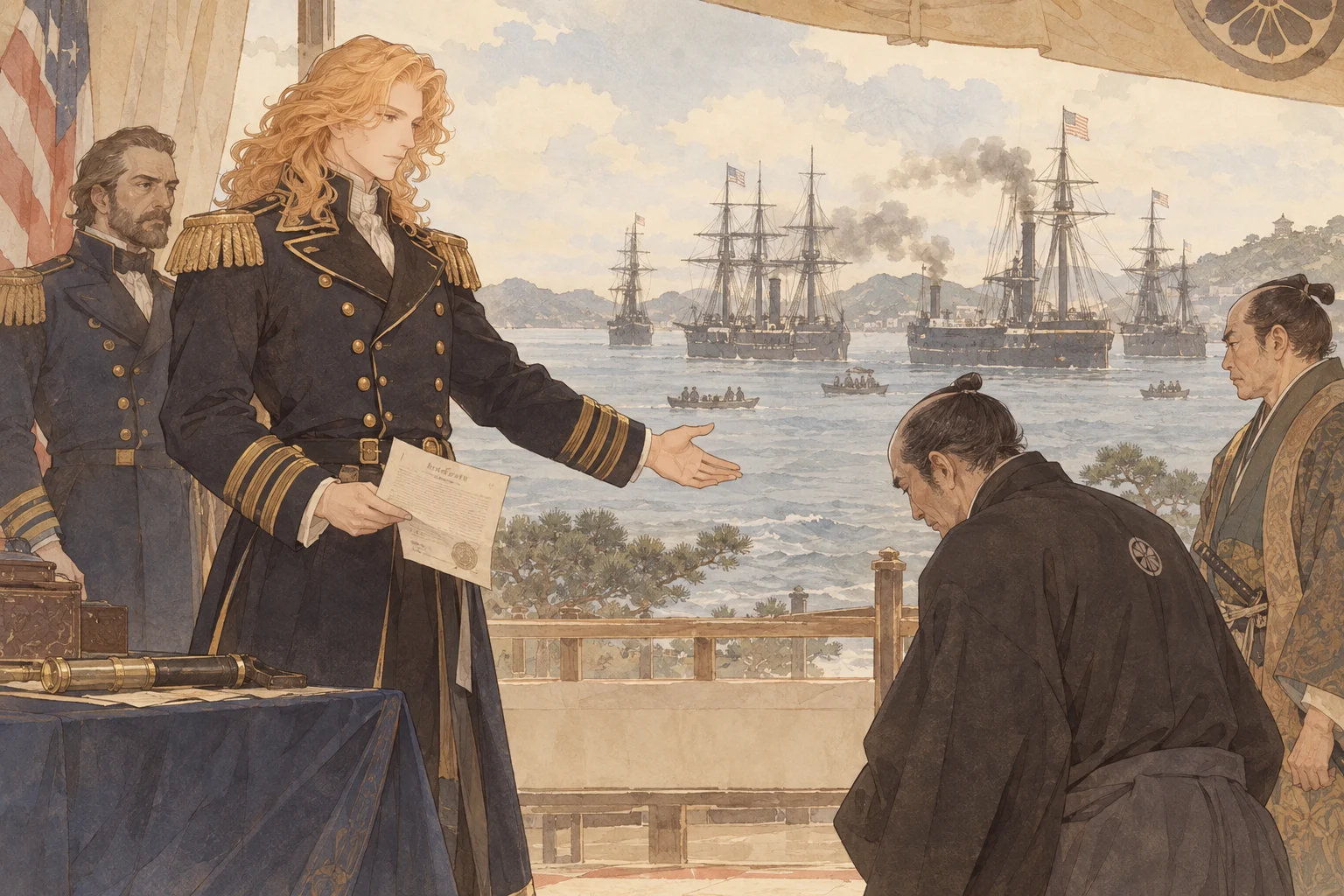
He proceeded to Edo Bay with four warships, keeping their guns in sight and demanding that the letters of government be accepted. The objective was to make the pressure visible rather than the content of the negotiations. He told them he would come back in a year, and left the deadline on the other side.
Control the field with +Se, and choose who to talk to with -Fi. It is a market-style quadra negotiation in which the display of power is designed to obtain practical benefits.
Although the short-term objective was achieved, it left a strong distrust on the Japanese side and distorted the assumptions for future relations.
Through competitive tactics, we will look at how this type moves to its strengths and how it is complemented by others. It does not determine your suitability for competition.
take the initiative by applying pressure

He continues to move forward, disrupting his opponent's breathing, and creating a form that looks superior even in judgments. Pre-match verbal exchanges are also included in the job of increasing box office value. The side that blocks the opponent's strengths and draws them into their own mold will push through.
Control the field with +Se, and choose who to team up with and compete with -Fi. At Quadra, where the idea is to earn money on your own, competition and entertainment are integrated.
The implication is +Ni. ILI-D The strategist's poker shows the technique of winning with expected value without moving.
Read how to organize people, resources, and judgment from real-life organizational examples. It does not determine the type of company, but rather an interpretation of the structure that appears in management.
Japan | Founded in 1960

Information on job openings and housing was collected in paper media, and the sales staff developed a system in which they cultivated customers one by one and sold slots. We provide individuals with numbers, visualize results, and continue to produce independent individuals. I stand on the side of creating places and gathering people and money.
Step into the market with +Se and choose a partner with -Fi. Quadra is based on the idea of earning money on your own, and is an organization built around the power of sales itself.
The implication is +Ni. ILI-D Strategist Berkshire Hathaway shows how to win through structure without moving.