
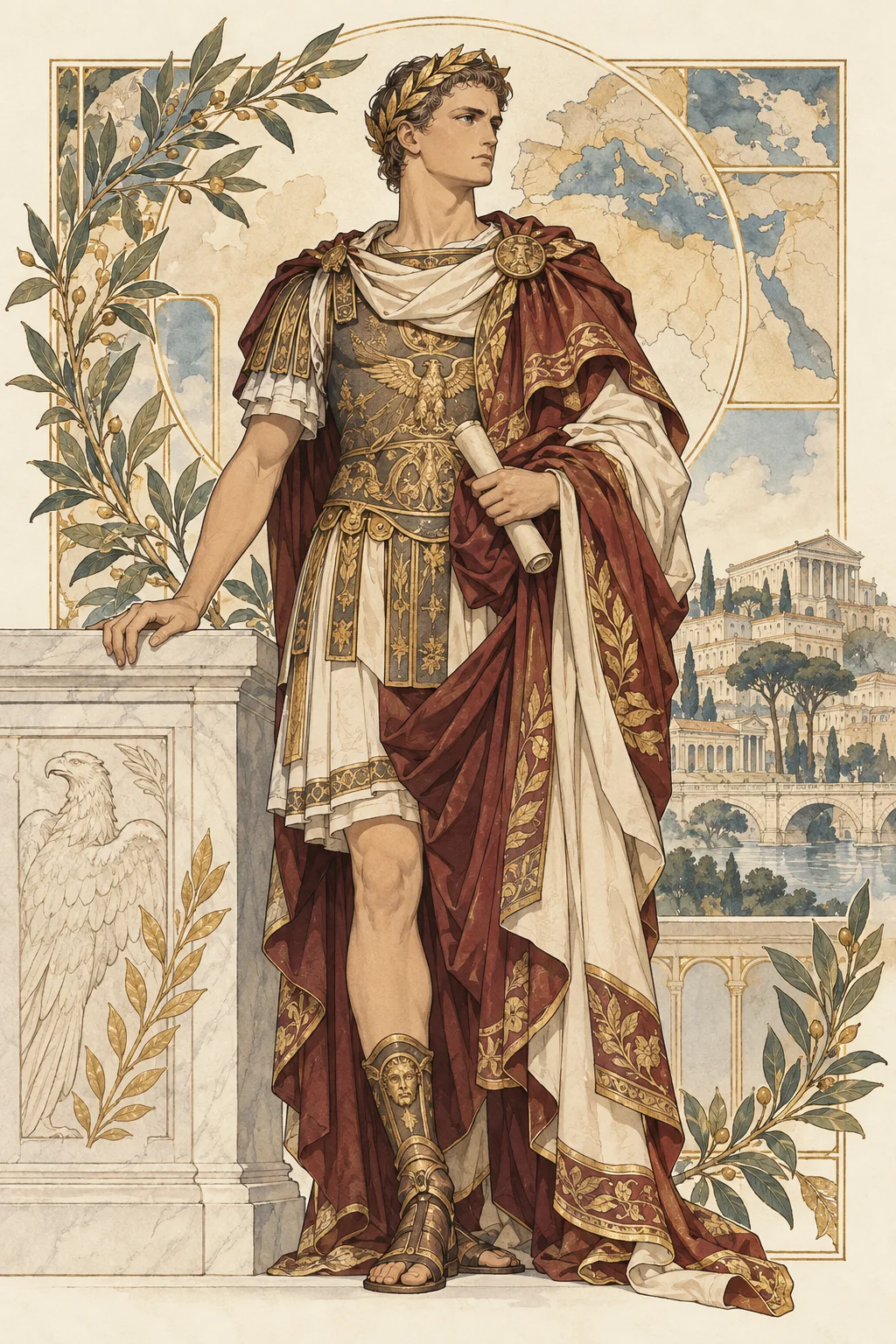
Augustus (Gaius Octavius)
LIE-Q "Commander" Emperor · Roman · 1st c. BC–1st c. ADFirst Emperor of ancient Rome (27 BC–14 AD). After defeating rivals following his adoptive father Caesar's assassination, he preserved the outward forms of the Republic while designing the "Principate" as effective autocracy. The "Pax Romana" — two centuries of relative peace — was his foundational achievement. The supreme institutional architect of Western history.
Leading Function+Te-p (Practicality & Economy)
"I found Rome a city of brick; I leave it a city of marble" — designing institutions, infrastructure, finances, and provincial governance as an integrated system is the core of +Te-p action. Loathing inefficiency; redesigning all administrative processes to optimise function.
Creative Function-Ni-c (Warning & Divergence)
Refusing the dictatorship when the people demanded it — "that repeats the power concentration that caused Caesar's death" — is the embodiment of -Ni-c creative function as anticipatory structural reading.
Vulnerable Function 1+Si-p weak (Comfort & Wellbeing)
Weak +Si-p (Comfort & Wellbeing): "He was entirely indifferent to personal adornment" (Suetonius) — managing chronic health problems through abstinence for the continuation of duty, not sensory pleasure.
Vulnerable Function 2-Fe-c weak (Harmony & Emotion)
Weak -Fe-c (Harmony & Emotion): "I do not engage emotionally" — his dying words, "Did I play my part well? Then applaud," as a confession of viewing his entire life as emotional performance from a detached perspective.
Quadra / Temperament / Club
Quadra: Anti-Alpha Quadra (Meritocracy) — utilising the Senate, tradition, and religion as instruments of the existing aristocratic order while engineering his own apex — the ancient embodiment of backstage meritocratic design.
Temperament: Linear-Assertive temperament: from youth, "declare and execute immediately when the moment is right" — waiting was a strategic choice; direction always announced forward. Advancing on Rome at 19 as Octavian.
Club: Researcher Club: devoting all energy to empirical design of institutions and administration rather than personal philosophical or artistic inclinations. Cultural patronage via Maecenas as "prestige engineering for Rome."
Worldview & Attitude
"Power must be both feared and legitimised" — a complex political realism. A worldview that sees structural dangers acutely and trusts institutional design as the only durable solution.
Attitude toward Change: Executing the Principate — a revolutionary transformation engineered as a stable realistic plan. Designing change to avoid the failure that killed Caesar.
