
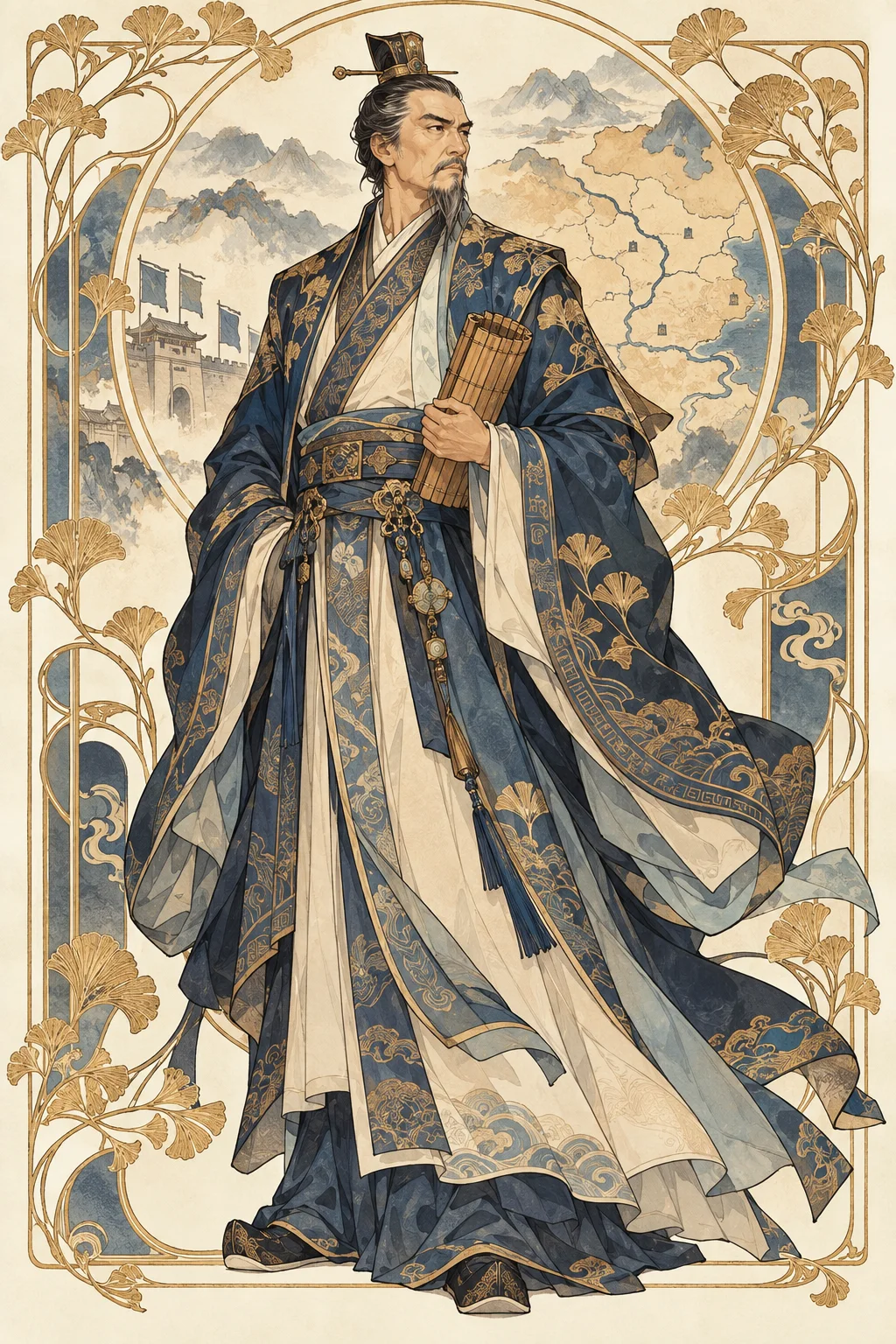
Guan Zhong
LIE-Q "Commander" Chancellor · Chinese (Qi) · 7th c. BCChancellor of the state of Qi, Spring and Autumn period China (c. 720–645 BC). Through salt and iron monopolies and the Light-Heavy economic theory, he elevated Qi to hegemon among the states. His story of serving his former enemy Duke Huan — the "friendship of Guan and Bao" — became a byword for loyalty transcending enmity. An ancient model of the statesman-economist.
Leading Function+Te-p (Practicality & Economy)
Salt and iron monopoly, the "Light-Heavy theory" (state price management), and standardisation of weights and measures — the first practitioner of state-directed market economics in the 7th century BC. Evaluated by Confucius himself as "a practitioner, not a theorist." Using everything "because it functions."
Creative Function-Ni-c (Warning & Divergence)
The complex warning in the Guanzi: "Wealth and military strength are the foundation of hegemony — but they border danger and collapse" — the core of -Ni-c. Designing the "second-best order" of interstate hegemony as a structural reading of the Zhou dynasty's coming collapse.
Vulnerable Function 1+Si-p weak (Comfort & Wellbeing)
Weak +Si-p (Comfort & Wellbeing): limited record of personal lifestyle, but the early record of "merchant origins, taking large profit" is +Te-p practical motivation clearly distinct from sensory inclination. Thin positive record of personal luxury or sensory indulgence.
Vulnerable Function 2-Fe-c weak (Harmony & Emotion)
Weak -Fe-c (Harmony & Emotion): "He achieved great things without benevolence or courtesy" (Confucius) — unanimous ancient and later evaluation that his attentiveness to collective emotional harmony and moral sentiment was weak.
Quadra / Temperament / Club
Quadra: Anti-Alpha Quadra (Meritocracy) — "Transition from hereditary aristocracy to professional bureaucracy": abolishing privilege by bloodline and designing meritocratic officialdom based on ability and results — the ancient practitioner of meritocratic governance.
Temperament: Linear-Assertive temperament: candid and forceful, speaking in numbers and facts. A consistent pattern of active choices repeated throughout his life.
Club: Researcher Club: analysing agriculture, commerce, military affairs, and diplomacy as an integrated state system before designing. The Guanzi as a text demonstrating deeper understanding of the interdependence of economics and politics than anyone of his era.
Worldview & Attitude
"Without sufficient food and clothing, people cannot learn courtesy" — a pragmatic realism. A worldview that sees structural dangers acutely and trusts economic institutional design as the response.
Attitude toward Change: Executing the salt-iron monopoly and Light-Heavy theory as realistic economic transformation — the ancient institutional designer.
