
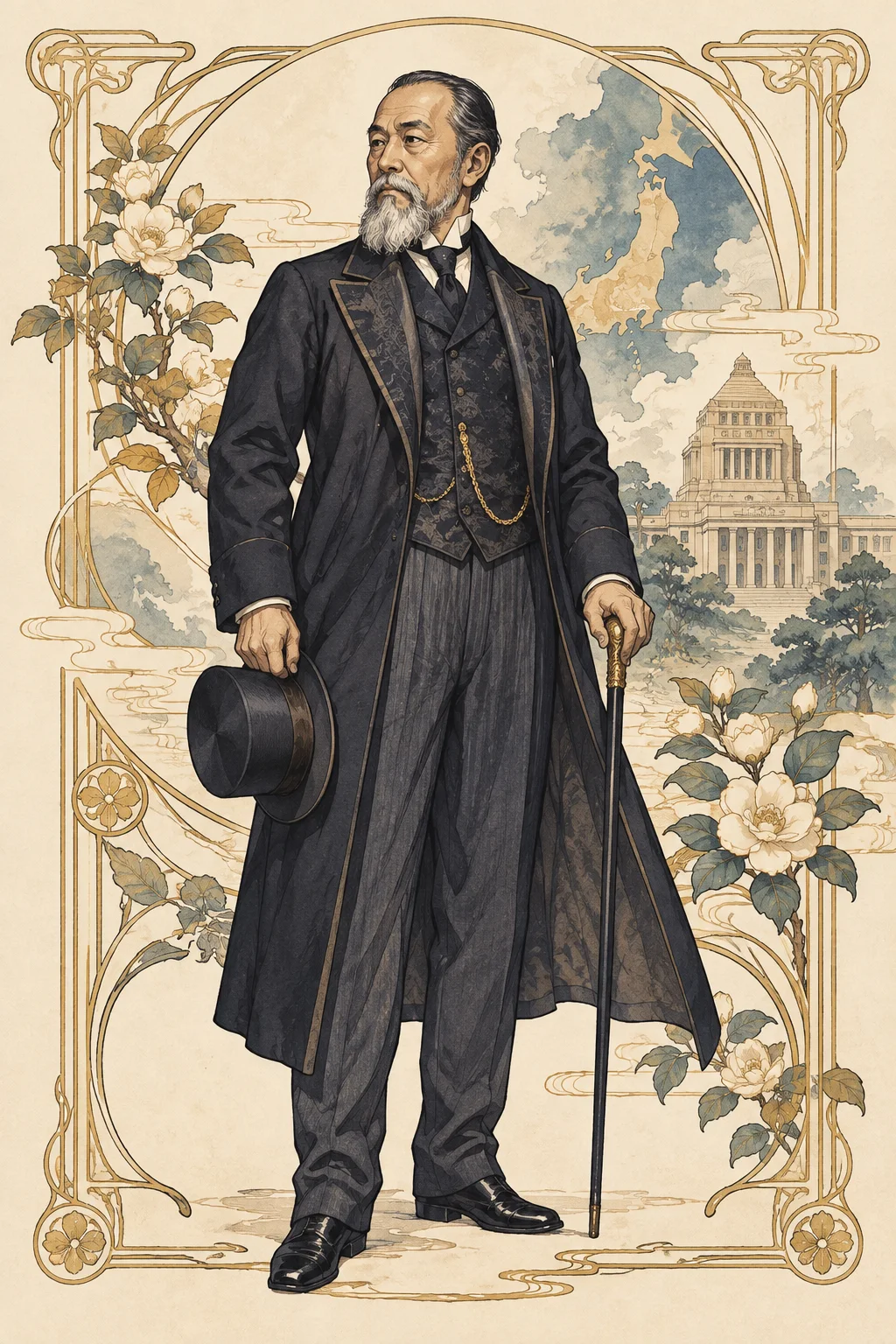
Itō Hirobumi
LIE-Q "Commander" Prime Minister · Japanese · 19th–20th c.Japan's first Prime Minister (1841–1909). He led the overseas constitutional survey for the Meiji government, drafted the Constitution of the Empire of Japan, and designed the cabinet system, imperial prerogative of supreme command, and Imperial Rescript on Education as the foundations of the modern Japanese state. Assassinated in Harbin — the supreme institutional architect of modern Japan.
Leading Function+Te-p (Practicality & Economy)
Spending 18 months studying German and Austrian constitutional systems first-hand — judging empirically that "the Prussian model functions for Japan" — before adopting it. The sole criterion: "does it function?" Rejecting the British and French models as incompatible with Japan's conditions.
Creative Function-Ni-c (Warning & Divergence)
"If Japan does not catch up with the Western powers, she will be colonised" — the collapse-anticipation at the core of his motivation for participating in the Meiji Restoration. "Parliamentary politics cannot function under a transcendent cabinet" — the structural foresight that led him to found a political party.
Vulnerable Function 1+Si-p weak (Comfort & Wellbeing)
Weak +Si-p (Comfort & Wellbeing): "From rough peasant's son to first Prime Minister" — consistent indifference to physical comfort and personal luxury throughout. The record of women is interpreted as -Se-p action (display of social prestige and presence) rather than sensory pleasure.
Vulnerable Function 2-Fe-c weak (Harmony & Emotion)
Weak -Fe-c (Harmony & Emotion): telling a subordinate calmly, "If you stop behaving like a loyal vassal, you could become Foreign Minister" — prioritising functional rationality over emotional loyalty as the typical action.
Quadra / Temperament / Club
Quadra: Anti-Alpha Quadra (Meritocracy) — designing and establishing the peerage system himself — institutionalising ability-based aristocracy. "Party politicians cannot deal with national interest objectively" — explicitly meritocratic elite governance.
Temperament: Linear-Assertive temperament: upon returning from his European survey, declaring "Japan will adopt a Prussian-style constitution" and immediately implementing it. A consistent pattern of declaring direction first, then building the institution.
Club: Researcher Club: comparing multiple nations' constitutional systems empirically and selecting the optimal model. English-language engagement with foreign media as a "practical tool for intelligence-gathering."
Worldview & Attitude
"Ideology is less important than institutions that function" — pragmatic conviction. A worldview that sees structural dangers acutely and trusts institutional design as the only reliable response.
Attitude toward Change: Executing the Meiji Constitution as a precisely engineered, realistic plan — the institutional designer of modern Japan, built for gradual, failure-resistant modernisation.
