
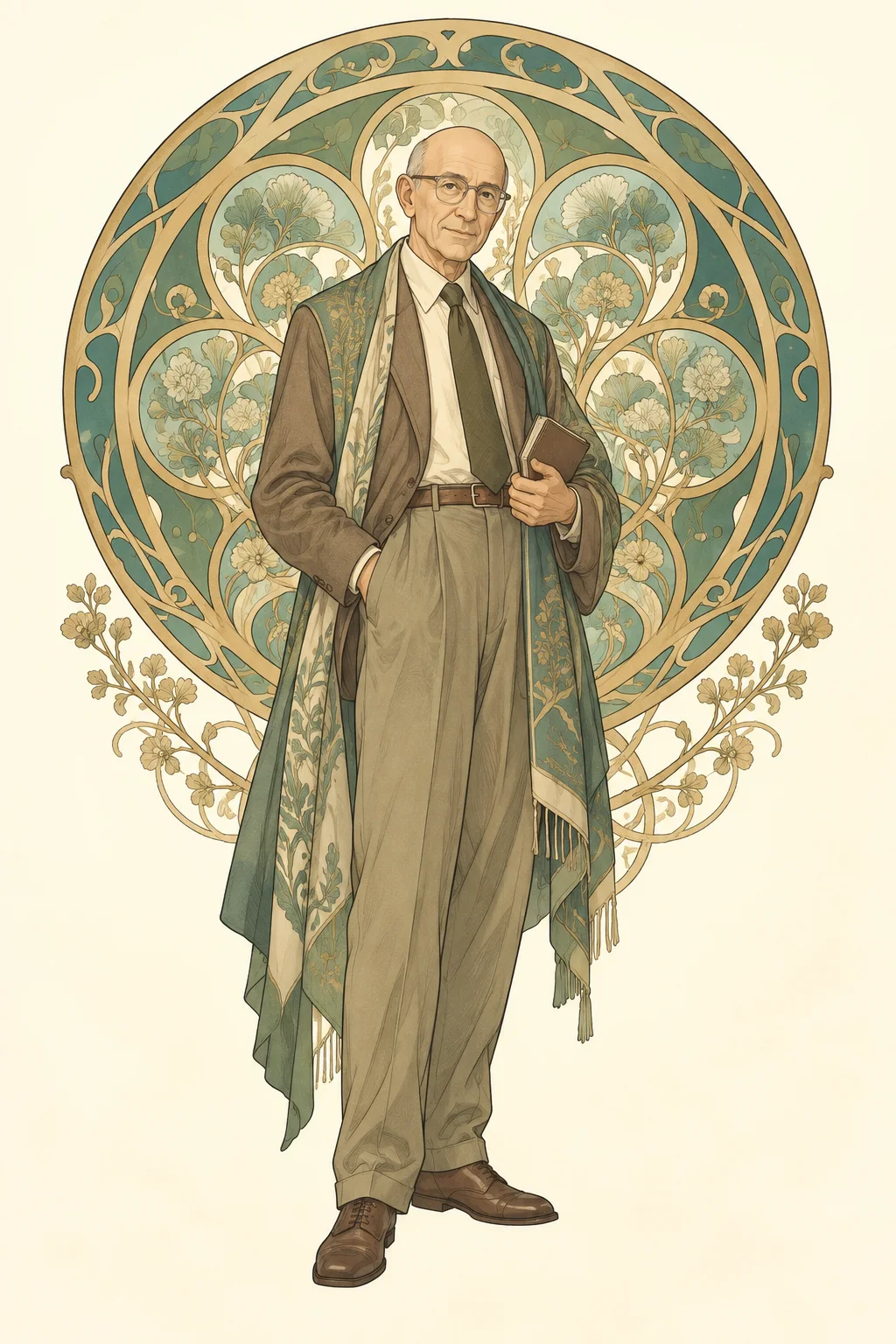
Carl Rogers
IEE-Q "Advisor" Psychologist · American · 20th c.American psychologist (1902–1987). He founded "client-centred therapy" and established a humanistic approach of "unconditional positive regard" as an alternative to authoritarian psychoanalysis. He also applied his person-centred approach to education, group work, and international peace-building — one of the most influential psychologists of the 20th century.
Leading Function+Ne-p (Creation & Innovation)
Diffuse trust in human potential — the core of +Ne-p action. Connecting client-centred therapy, experiential learning, and peace-building to expand the boundaries of psychology. The concept of non-directive therapy as a new framework that "no one had yet articulated."
Creative Function-Fi-c (Sincerity & Reconciliation)
The consistent life posture of "how does that make you feel?" — opening the other person's emotional lid and drawing out their authentic voice — as the -Fi-c creative function. Developing the concept of the internal locus of evaluation: helping clients find their own authentic judgement.
Vulnerable Function 1+Ti-p weak (Organization & Law)
Weak +Ti-p: documented difficulty adapting to academic organisations and university administration throughout his life — consistently standing outside institutional structures.
Vulnerable Function 2-Se-c weak (Discipline & Order)
Weak -Se-c: thoroughly prioritising relationship and dialogue over disciplined organisational management. Prioritising emotionally authentic exchange over research protocol compliance led to repeated conflict with experimental psychology.
Quadra / Temperament / Club
Quadra: Anti-Beta Quadra (Civil Society) — fundamental scepticism of authority, institutions, and hierarchical therapeutic relationships runs through all his work. Rejecting the authoritarian model of "the expert heals the patient" and trusting in human self-healing capacity.
Temperament: Flexible-Maneuvering temperament: flexibly shifting roles across clinical work, academia, ideas, and international mediation. Adapting style to the current dialogue partner and context rather than fixing on a professional identity.
Club: Humanitarian-Artistic Club: human growth and healing as the lifelong core. Positioning psychotherapy as artistic dialogue rather than scientific management.
Worldview & Attitude
"Humans have the capacity for self-actualisation" — fundamental trust in human potential. A positive worldview that sees complexity as navigable through authentic relationship.
Attitude toward Change: A symbol of hope for non-directive therapy as transformation — pointing the direction while leaving implementation to the era and to successors.
