
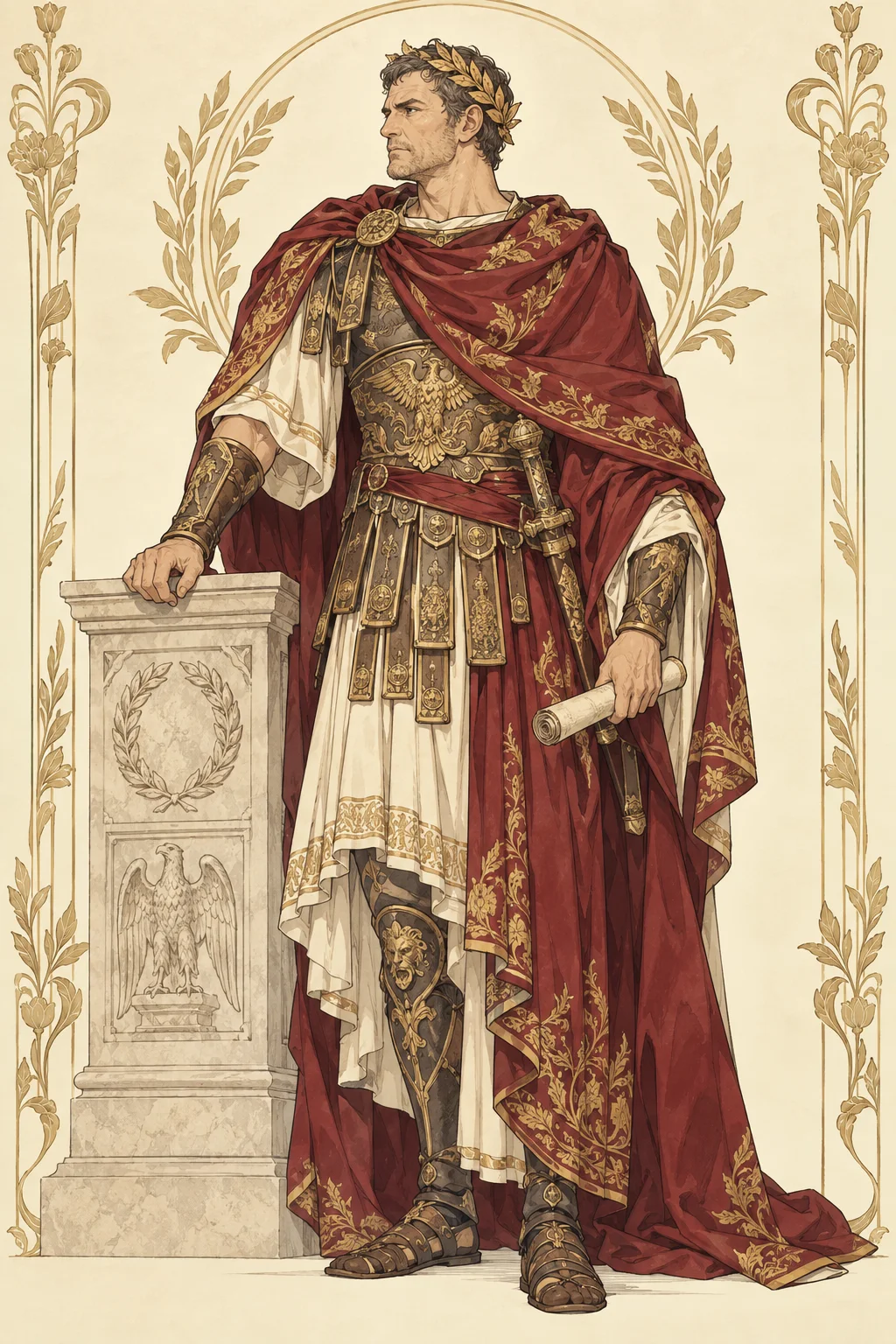
Diocletian
LSI-D "Enforcer" Emperor · Roman · 3rd–4th c.Roman Emperor (244–311). He ended the "Crisis of the Third Century" and designed the "Tetrarchy" system of four co-emperors to govern the divided empire. His administrative reforms — the most thorough in Roman history — and his largest-scale persecution of Christians define his legacy. His voluntary abdication — unprecedented for a Roman emperor — and retirement to his palace in Split (modern Croatia) remain subjects of historical fascination.
Leading Function+Ti-p (Organization & Law)
"Built the largest bureaucratic government in history" — dividing provinces from 50 to over 100, separating military and civil administration, designing the legal framework of the Tetrarchy, reforming the tax system on a 15-year cycle of census and reassessment.
Creative Function-Se-c (Discipline & Order)
Reorganising the army and "restoring discipline to the old standard." Cold-blooded response to inflation through the Edict on Maximum Prices (violators subject to death). The persecution of Christians also framed as "eliminating violators of the empire's unified religious order."
Vulnerable Function 1+Ne-p weak (Creation & Innovation)
Weak +Ne-p: "conservative — guardian of traditional Roman religion," "resistant to change." The Tetrarchy also conceived as "repairing the near-collapsed empire with existing principles" rather than "creating an innovative new institution."
Vulnerable Function 2-Fi-c weak (Sincerity & Reconciliation)
Weak -Fi-c: trust in co-emperor Maximian based on "confirmation of ability and loyalty" — an instrumental relationship with virtually no record of personal emotional bond. After abdication, responding to Maximian's resumption of power not emotionally but through legal-institutional logic.
Quadra / Temperament / Club
Quadra: Beta Quadra (Empire) — sacralising absolute authority as "representative of the god Jupiter" (Beta mission conviction). Viewing the empire as "the embodiment of order to be defended" — strict aristocratic re-hierarchicalisation.
Temperament: Balanced-Stable temperament: voluntary abdication after 21 years of rule (first in Roman imperial history) — only a Balanced-Stable figure without emotional attachment to power could do this.
Club: Pragmatist Club — solving imperial problems not through "religious vision" or "personal charisma" but through "administrative system, military organisation, tax system." The Tetrarchy as "solving an organisational problem with organisation."
Worldview & Attitude
"The empire cannot be governed by one person" — realism. Trust in institutional order as the only reliable foundation for large-scale governance.
Attitude toward Change: Executing the Tetrarchy as a realistic plan — failure-resistant power distribution engineered for imperial stability.
