
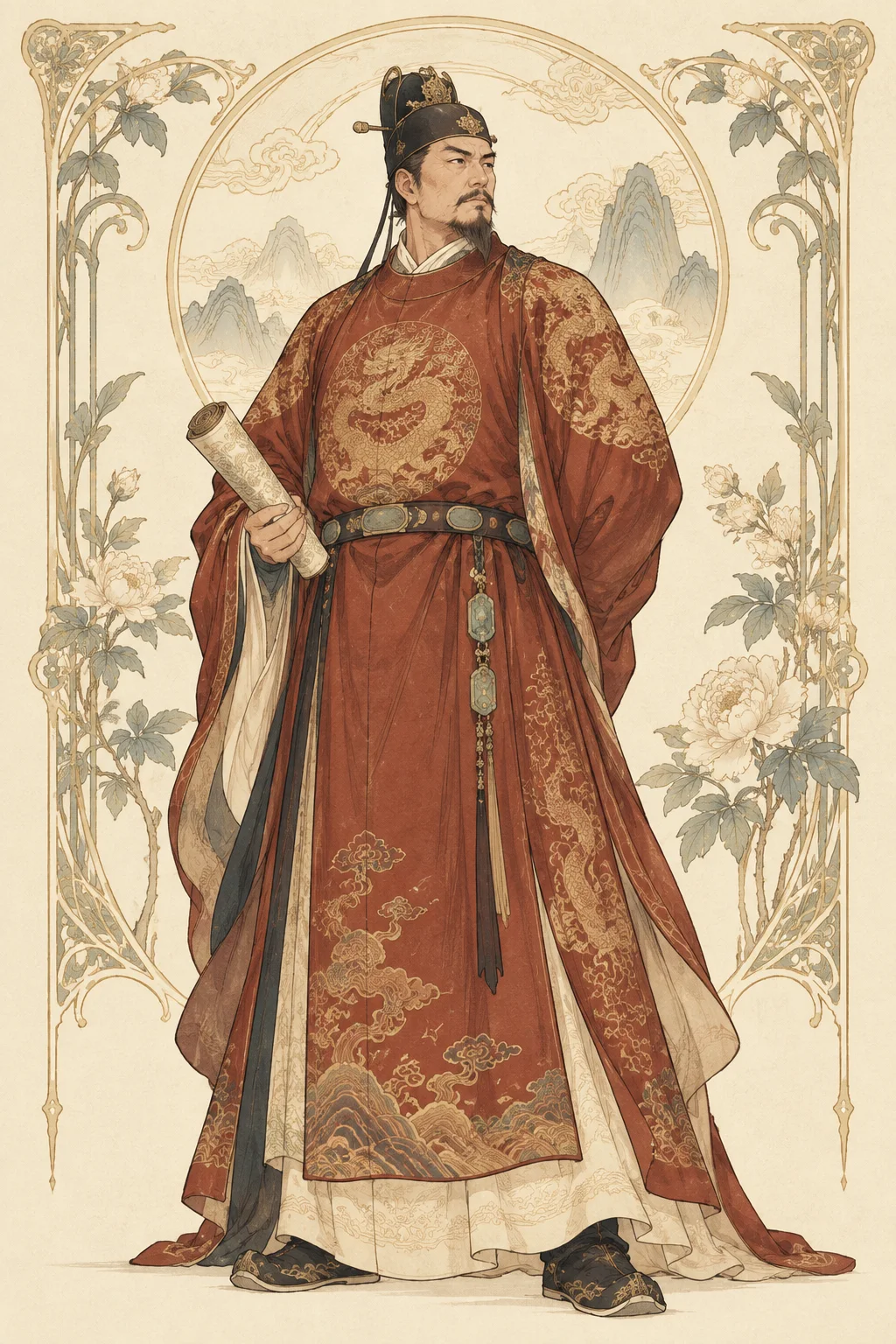
Zhu Yuanzhang (Hongwu Emperor)
LSI-D "Enforcer" Emperor · Chinese · 14th c.First Emperor of the Ming dynasty (1328–1398). The most dramatic rags-to-emperor story in Chinese history — from the lowest peasant origins through monk and bandit to overthrow the Yuan dynasty and found the Ming. Proclaiming anti-corruption while successively eliminating meritorious subjects — a supreme paradox. His institutional designs, including the Da Ming Huidian, shaped Chinese governance for centuries.
Leading Function+Ti-p (Organization & Law)
Personally directing the design of the Da Ming Huidian (Ming Code) — "structured to prevent misunderstanding," a comprehensive 30-volume legal system. Abolishing the position of Chancellor and making the Six Ministries directly subordinate to the emperor — a turning point in Chinese political history.
Creative Function-Se-c (Discipline & Order)
"Officials who accept bribes of more than 60 taels shall be flayed and their skin stuffed with straw." The most extreme example of institutionalising disciplinary enforcement — corruption punished by public anatomical display as a deterrent.
Vulnerable Function 1+Ne-p weak (Creation & Innovation)
Weak +Ne-p: "disliking scholars who rely on books" — fundamental distrust of new ideas. The maritime prohibition (sea ban) blocking foreign new technologies and thought. After expelling Mongol rule: "return to ancient Chinese models."
Vulnerable Function 2-Fi-c weak (Sincerity & Reconciliation)
Weak -Fi-c: old comrades who fought at the risk of their lives — Xu Da, Chang Yuchun, Li Shanchang — successively purged or driven to their deaths in his later years. "Whether dangerous to imperial order" was the sole criterion; personal friendship and loyalty counting for nothing.
Quadra / Temperament / Club
Quadra: Beta Quadra (Empire) — "mandate of heaven" as Beta mission justification for rule. Legal establishment of strict class hierarchy, "liberation of China from Yuan (Mongol) alien rule" as Beta collective mission.
Temperament: Balanced-Stable temperament: surviving over 20 years as a beggar, itinerant monk, and peasant rebel foot-soldier — extraordinary mental resilience. Maintaining 40 years of rule without emotional breakdown in fundamental loneliness trusting no one.
Club: Pragmatist Club — using Buddhism, Confucianism, and Taoism as "governance tools" without believing them. Agricultural promotion, irrigation, land registration — all about "how to manage the huge imperial organisation."
Worldview & Attitude
"Power is maintained by fear" — a dark view of human nature. Trust in disciplined institutional order as the only reliable foundation for stable governance.
Attitude toward Change: Executing the founding of the Ming dynasty as a realistic plan — the purging of meritorious subjects as failure-resistant power consolidation.
