
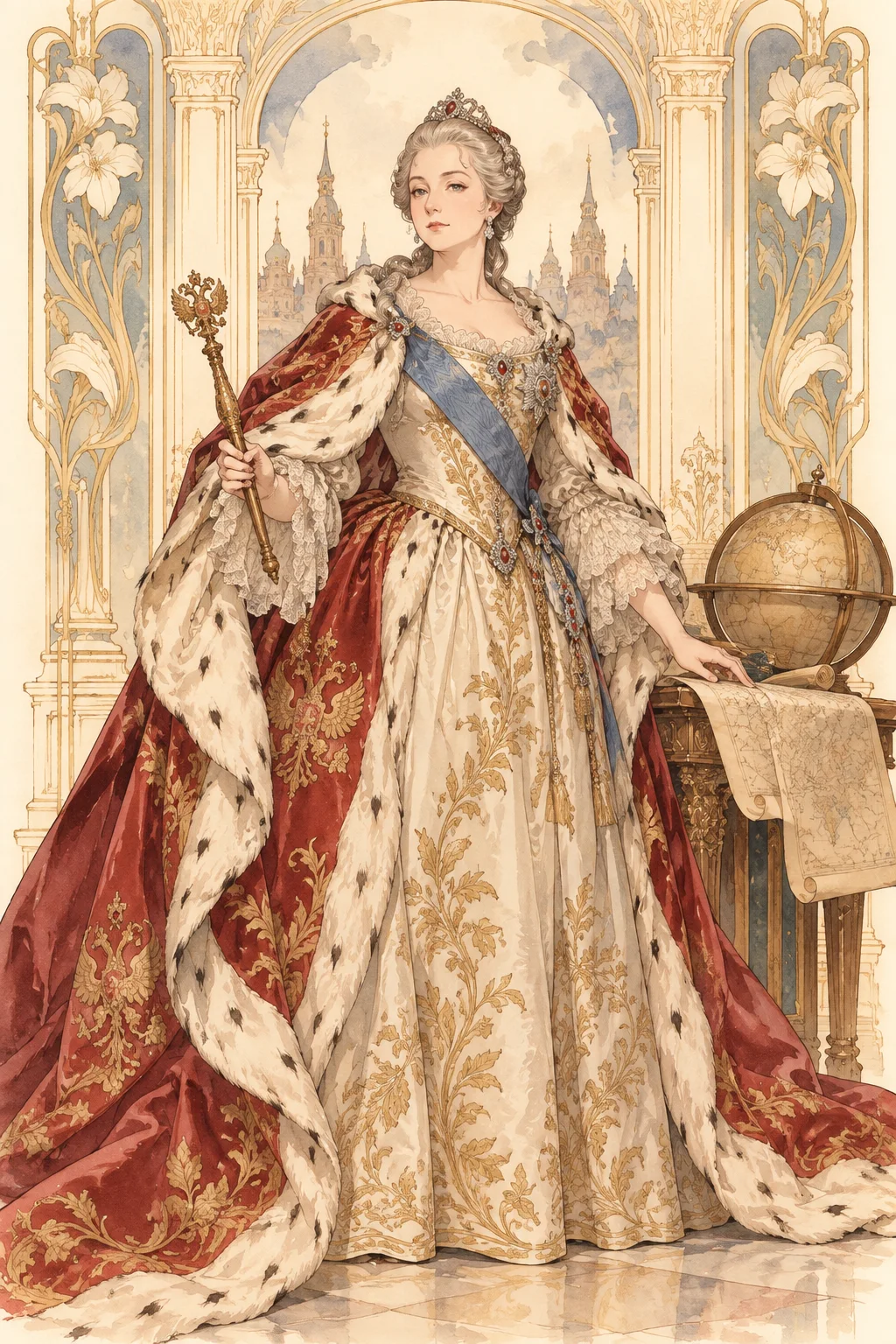
Celebrity Index SEE-D "Politician" Catherine the Great

Catherine the Great

SEE-D "Politician" Empress · Russian · 18th c.

Russian Empress (1729–1796). Born German, she married into the Russian royal family, deposed her husband Peter III in a coup, and reigned for 34 years. Corresponding with Voltaire while strengthening serfdom and expanding territory — one of the most powerful rulers in Russian history, combining Enlightenment image with imperial realpolitik.

Leading Function-Se-p (Victory & Dominance)

Exercising dominating influence in political and social settings — direct appeal to those who hold power — is the consistent -Se-p pattern throughout her life.

Creative Function+Fi-c (Influence & Motivation)

Reading and manipulating the true emotions of court figures, nobles, and commoners — the core of +Fi-c creative function. Building emotional connections with Enlightenment thinkers through correspondence; managing nobles' emotional submission through social events.

Vulnerable Function 1-Ti-p weak (Structure & Truth)

Weak -Ti-p (Structure & Truth): proclaiming Enlightenment while not abolishing serfdom — prioritising political impression management over ideological consistency. Creating the narrative of "Enlightened monarch" while avoiding the logical follow-through of systematic reform.

Vulnerable Function 2+Ne-c weak (Hypothesis & Imagination)

Weak +Ne-c (Hypothesis & Imagination): after Pugachev's Revolt (1773), abandoning all innovative visions of serf reform and converting entirely to conservative status quo maintenance.

Quadra / Temperament / Club

Quadra: Anti-Alpha Quadra (Meritocracy) — constructing a new order of Russian modernisation as the guiding principle.

Temperament: Flexible-Maneuvering temperament: switching entirely different roles — always naturally adapting to the present situation.

Club: Socialite Club: personal intellectual exchange through correspondence with Voltaire and Diderot, combined with cultural collection at the Hermitage as the court network maintenance.

Worldview & Attitude

"Enlightenment ideals and imperial governance can coexist" — a complex political realism. Acutely aware of structural dangers and trusting in cultural-relational authority.

Attitude toward Change: A practitioner of transformation and counter-transformation — proclaiming serf abolition while actually strengthening serfdom: the realist of adaptive governance.