
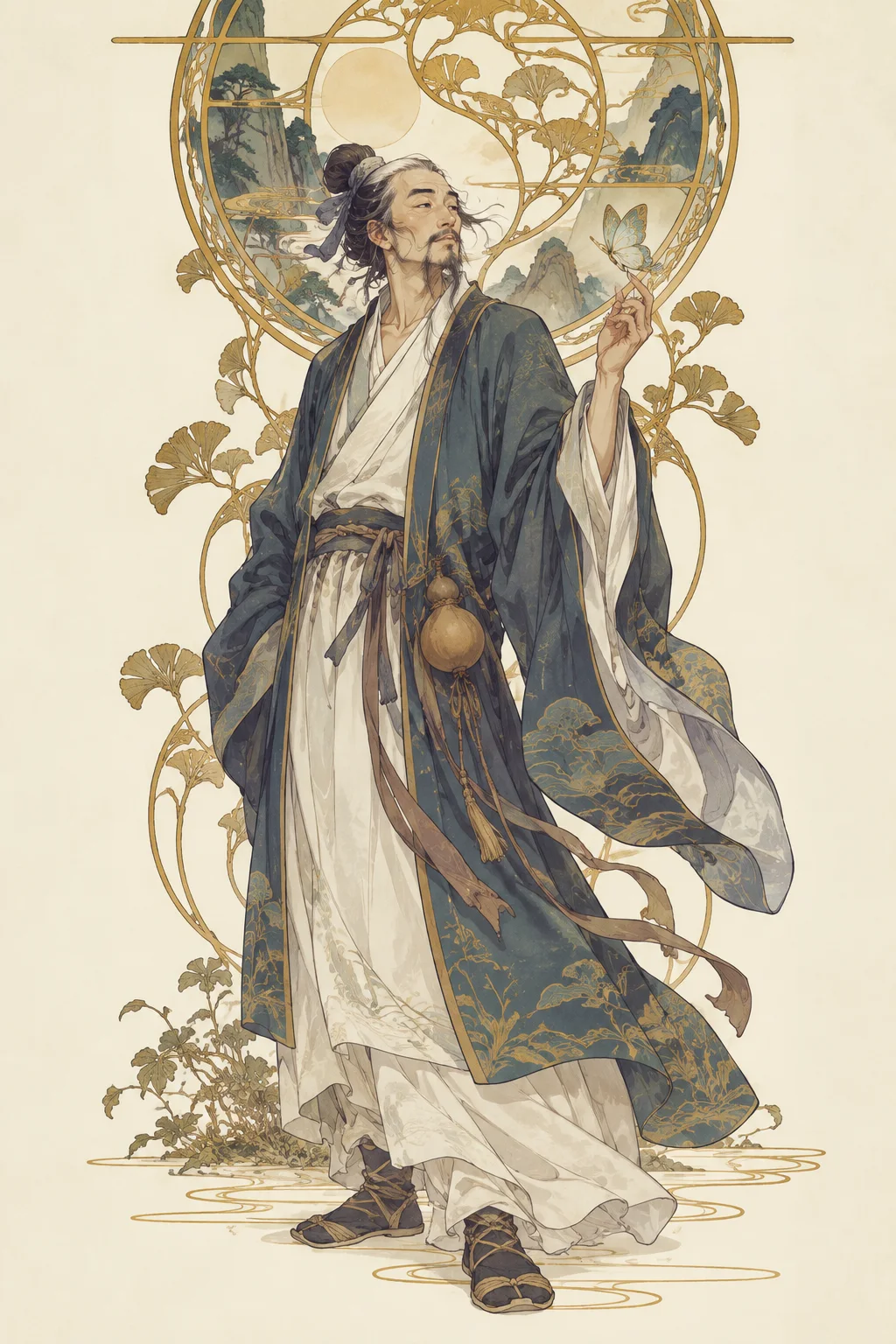
Zhuangzi (Zhuang Zhou)
ILE-D "Visionary" Philosopher · Chinese · 4th–3rd c. BCWarring States period Taoist philosopher (c. 369–286 BC). Co-authoring the Daoist source alongside Laozi, he wrote Zhuangzi presenting fables such as "Butterfly Dream" and "Cook Ding's Ox-Carving." His influence on Chinese literature, Zen Buddhism, and East Asian thought is incalculable.
Leading Function-Ne-p (Paradox & Insight)
"The Butterfly Dream" — "Am I a butterfly, or is a butterfly me?" as the fundamental paradox of existence. "The useless tree lives longest" — the paradox of utility. "Cook Ding's ox-carving" — the paradox of transcending technique.
Creative Function+Ti-c (Precision & Thoroughness)
"Qi Wu Lun (On the Equality of Things)" — a complete systematic systematisation that all value judgements are relative. Developing paradoxes with precision through combinations of fable, metaphor, and logic.
Vulnerable Function 1-Fi-p weak (Compassion & Consideration)
Weak -Fi-p: "Beating an earthen jar and singing" at his wife's death — an extremely unusual expression of personal grief, the archetypal collapse of -Fi-p weakness.
Vulnerable Function 2+Se-c weak (Reality & Common Sense)
Weak +Se-c: "Wu wei (non-action)" — intentionally abandoning everyday practical tasks and common-sense action. Immersion in the logic of nature transcending practical technique.
Quadra / Temperament / Club
Quadra: Anti-Gamma Quadra (Utopia) — fundamental criticism of the Confucian orderly value system as γ values. Total rejection of the human-made γ activities of power, competition, and ownership.
Temperament: Flexible-Maneuvering temperament: the optimistic openness of "Xiaoyaoyou (free and easy wandering)" and the extroverted impulse of beating earthen jars and singing.
Club: Researcher Club: philosophical dialogue with Huizi — Researcher Club-type dialogue deepening thought through discussion.
Worldview & Attitude
"Civilisation and social institutions distort the natural way of human beings" — the direct statement of present reality. The ないもの (a world of perfect naturalness) is not proclaimed.
Attitude toward Change: Zen Buddhism, Taoism, and postmodern philosophy catching up 2,400 years later — "the waiting" posture of the pioneer.
