
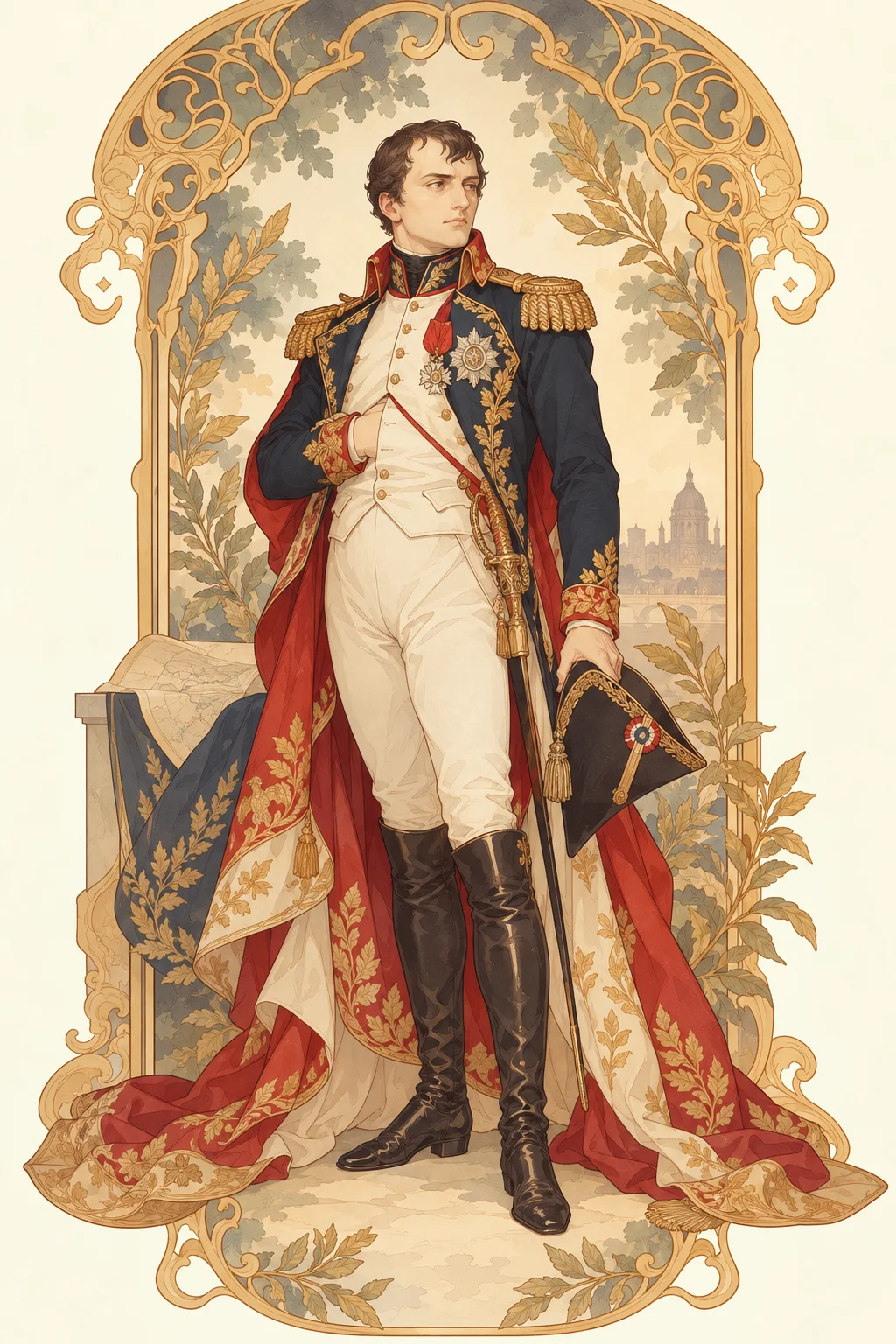
Napoleon Bonaparte
SEE-Q "Orchestrator" Emperor · French · 18th–19th c.Emperor of France (1769–1821). From Corsican artillery officer through mastering the chaos of the French Revolution to imperial throne. He reformed France through the Napoleonic Code, educational system, and administrative institutions. Transforming the map of Europe through military conquest, he was ultimately exiled to Saint Helena. The defining figure of the age that bears his name — and perhaps the greatest advertisement for the dangers of individual genius without institutional succession.
Leading Function+Se-p (Achievement & Protection)
The impulse to achieve the greatest military feat in history — European conquest — as the core of +Se-p action. Personal presence at the front at Austerlitz and Jena as the commanding drive for heroic achievement.
Creative Function-Fi-c (Sincerity & Reconciliation)
Appealing to soldiers' loyalty and the authentic emotions of the people — the core of -Fi-c creative function. Personal emotional appeals to soldiers upon the return of the Hundred Days; the Napoleon myth as emotional resonance with popular feeling.
Vulnerable Function 1+Ti-p weak (Organization & Law)
Weak +Ti-p: relative documented weakness in the systematic management of the Napoleonic Code. Prioritising personal emotional judgement over institutional legal system design in critical moments.
Vulnerable Function 2-Ne-c weak (Common Sense & Peace)
An expression of -Ne-c weak (Common Sense & Peace): by concentrating on current military dominance (+Se-p), the signal of "the natural equilibrium of the Russian campaign's limits — the turning point requiring retreat" — already felt by many staff officers — was exceeded. That signal was consistently overridden by the prioritisation of conquest.
Quadra / Temperament / Club
Quadra: Gamma Quadra (Market) — combining military genius, self-mythologisation, and institutional redesign to dominate Europe as a power market.
Temperament: Flexible-Maneuvering temperament: switching entirely different roles — revolutionary general, First Consul, Emperor, exile, historical myth — in response to the situation.
Club: Socialite Club: standing at the centre of entirely different social networks — revolutionary army officers, scientists, diplomats, European monarchs — in response to the situation, and building the imperial governance base through personal attraction.
Worldview & Attitude
"A talented individual can make history" — optimistic individualism. A worldview that trusts in the power of personal genius.
Attitude toward Change: Executing the Napoleonic Code as a realistic transformation plan — while leaving the long-term stability to others.
