
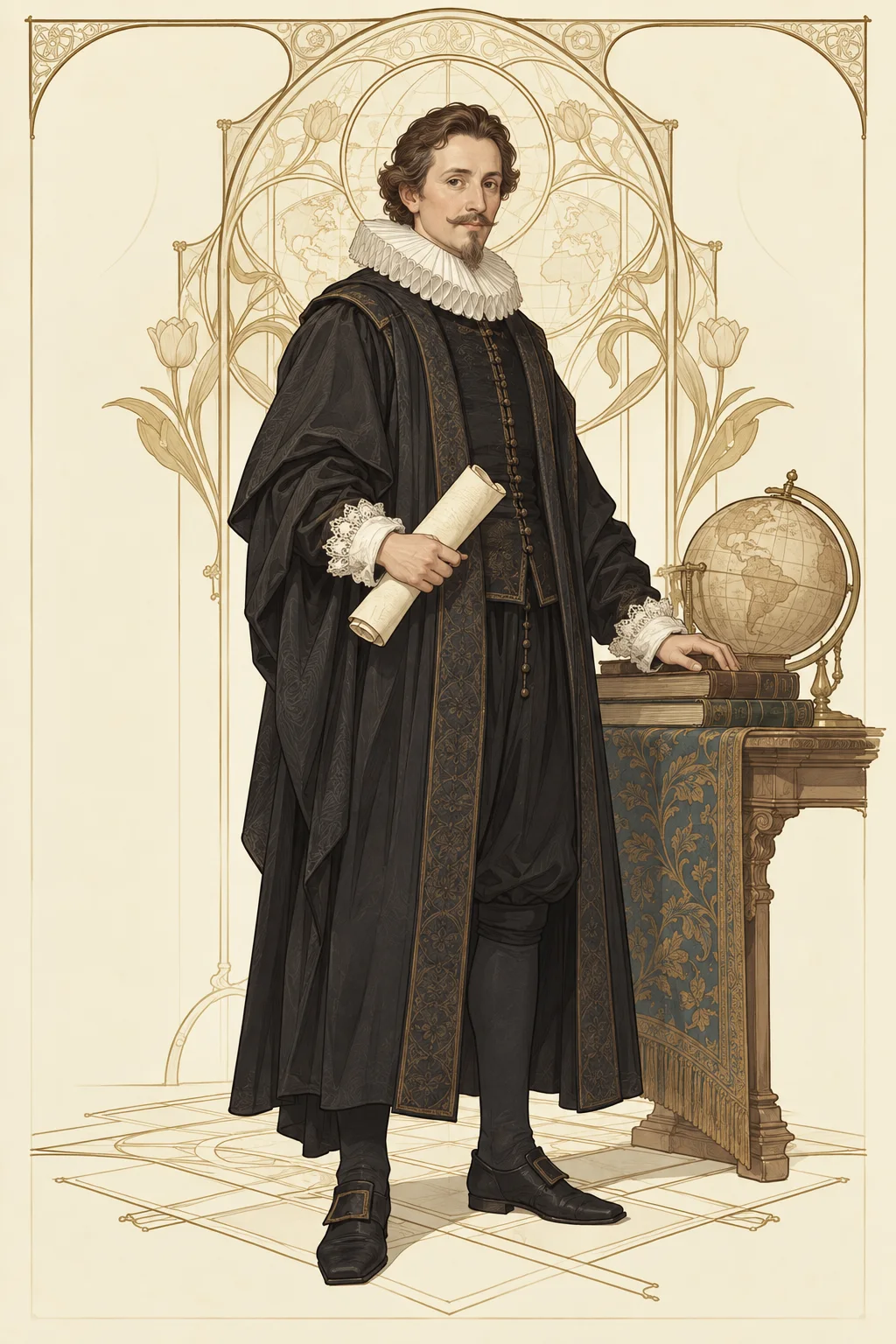
Hugo Grotius
LII-D "Architect" Lawyer / Diplomat · Dutch · 16th–17th c.Dutch lawyer and diplomat (1583–1645). In The Law of War and Peace he laid the foundations of international law — "the father of international law." The conceptual architect of the international legal order that still governs relations between states.
Leading Function+Ti-p(組織と法律)
"The Law of War and Peace" (1625) — the cornerstone of international law, regulating relations between states through natural law. The "freedom of the seas principle" — the ocean belongs to no one.
Creative Function-Ne-c(良識と平和)
"Even in war, law should be observed" — institutionalising rational rules even within violence. Lifelong effort for "unification of Christian denominations" — a Common Sense & Peace approach.
Vulnerable Function 1+Se-p弱(偉業と庇護)
Weak +Se-p: escaping from life imprisonment hidden in a book chest — only a passive response of flight. Attempting to return home but fleeing again.
Vulnerable Function 2-Fi-c弱(本心と和解)
Weak -Fi-c: last words: "Having understood much, I have accomplished nothing" — dying unable to achieve emotional self-acceptance. Deep dependence on wife Maria.
Quadra / Temperament / Club
Quadra: Anti-Gamma Quadra (Utopia) — "An institutional community of international society is achievable" — the optimistic conviction as -γ embodiment.
Temperament: Balanced-Stable temperament: continuing to write even in prison. Requesting a guarantee of never being dismissed — prioritising stability.
Club: Researcher Club: intellectual friendships with Erasmus, Heinsius, and Vossius — the archetypal centre of a Researcher Club.
Worldview & Attitude
"The international violence and lawlessness between states exist" — the direct statement of present reality. The ないもの (a world of international law universally respected) is not proclaimed.
Attitude toward Change: A pioneer pointing the direction of international law — escaping in a bookcase as "the waiting" posture.
