
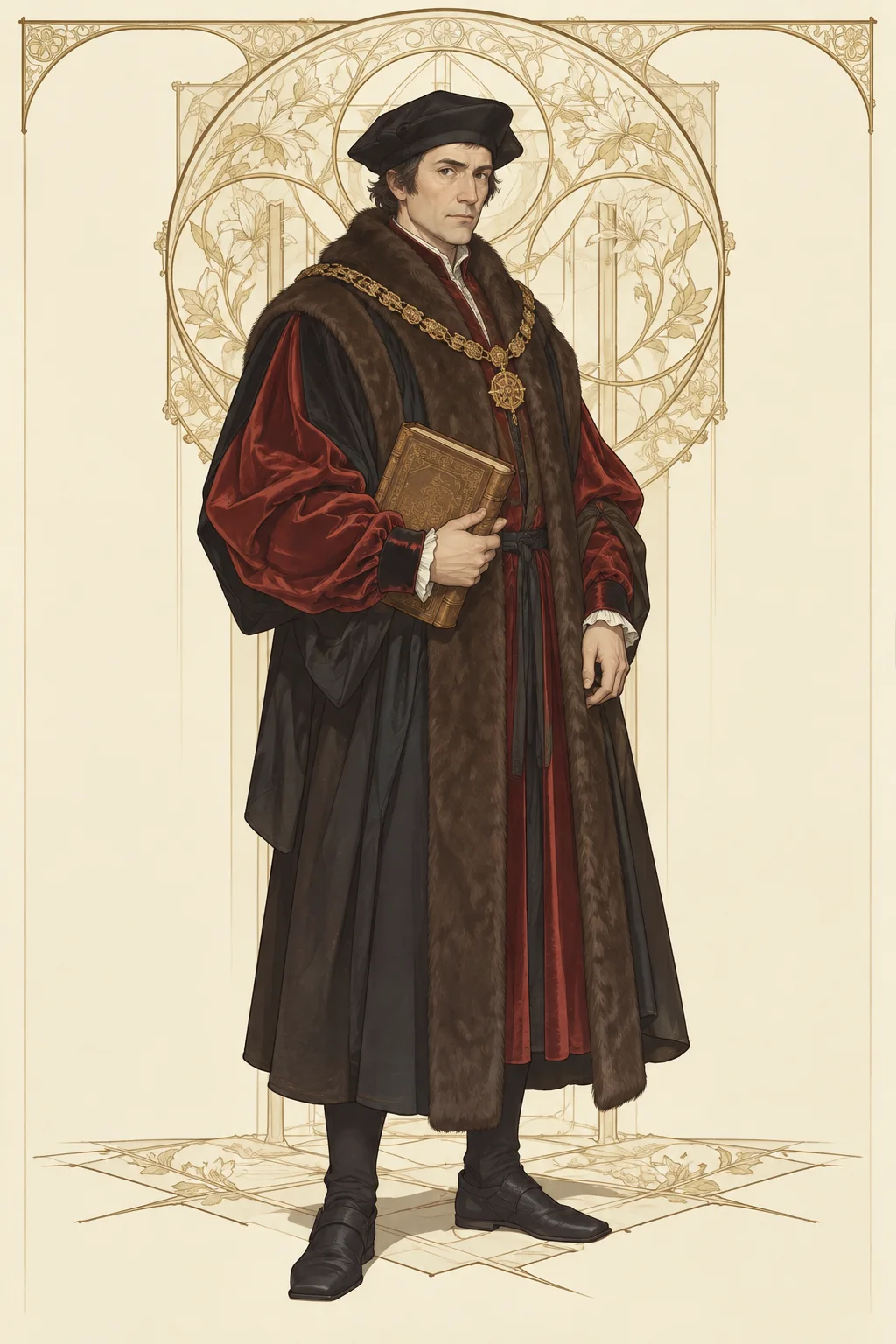
Thomas More
LII-D "Architect" Lawyer / Thinker · British · 15th–16th c.English lawyer and thinker (1478–1535). Depicting an ideal communist community in Utopia, he was executed for refusing Henry VIII's break from Catholicism. Canonised as a saint and martyr. Hilary Mantel's Wolf Hall trilogy reinvigorated his historical reputation.
Leading Function+Ti-p(組織と法律)
"Utopia" (1516) — a precisely logical blueprint for an ideal community incorporating shared property, 6-hour work days, religious tolerance, and women's education. Processing lawsuits with "unprecedented speed" as Lord Chancellor.
Creative Function-Ne-c(良識と平和)
"Maintained silence" — choosing the gentle resistance of wise silence in response to Henry VIII's pressure. Declining the oath: "I cannot say the reason, but it conflicts with my conscience."
Vulnerable Function 1+Se-p弱(偉業と庇護)
Weak +Se-p: completely breaking down under Henry VIII's impossible demands. Resigning as Lord Chancellor citing chest pain — a somatised stress response.
Vulnerable Function 2-Fi-c弱(本心と和解)
Weak -Fi-c: "Without saying ill of anyone, without hurting anyone" until execution — unable to express personal innermost feelings to the end.
Quadra / Temperament / Club
Quadra: Anti-Gamma Quadra (Utopia) — the communist-communal community of "Utopia" — shared property as the -γ core. "Friend of the poor" — using law to challenge γ privilege structures.
Temperament: Balanced-Stable temperament: devoting early mornings to scholarship while continuing deliberation. Maintaining silence to the end without sudden direction changes.
Club: Researcher Club: deep intellectual friendship with Erasmus — living within a knowledge community. Utopia written in Latin as an intellectual dialogue for humanists.
Worldview & Attitude
"The corruption of the church and the tyranny of the king exist" — the direct statement of present reality. The ないもの (a utopian world) is not proclaimed.
Attitude toward Change: Pointing the direction of Utopia as transformation, then carrying realistic plans as Lord Chancellor — "the waiting" posture of principled silence at the scaffold.
