
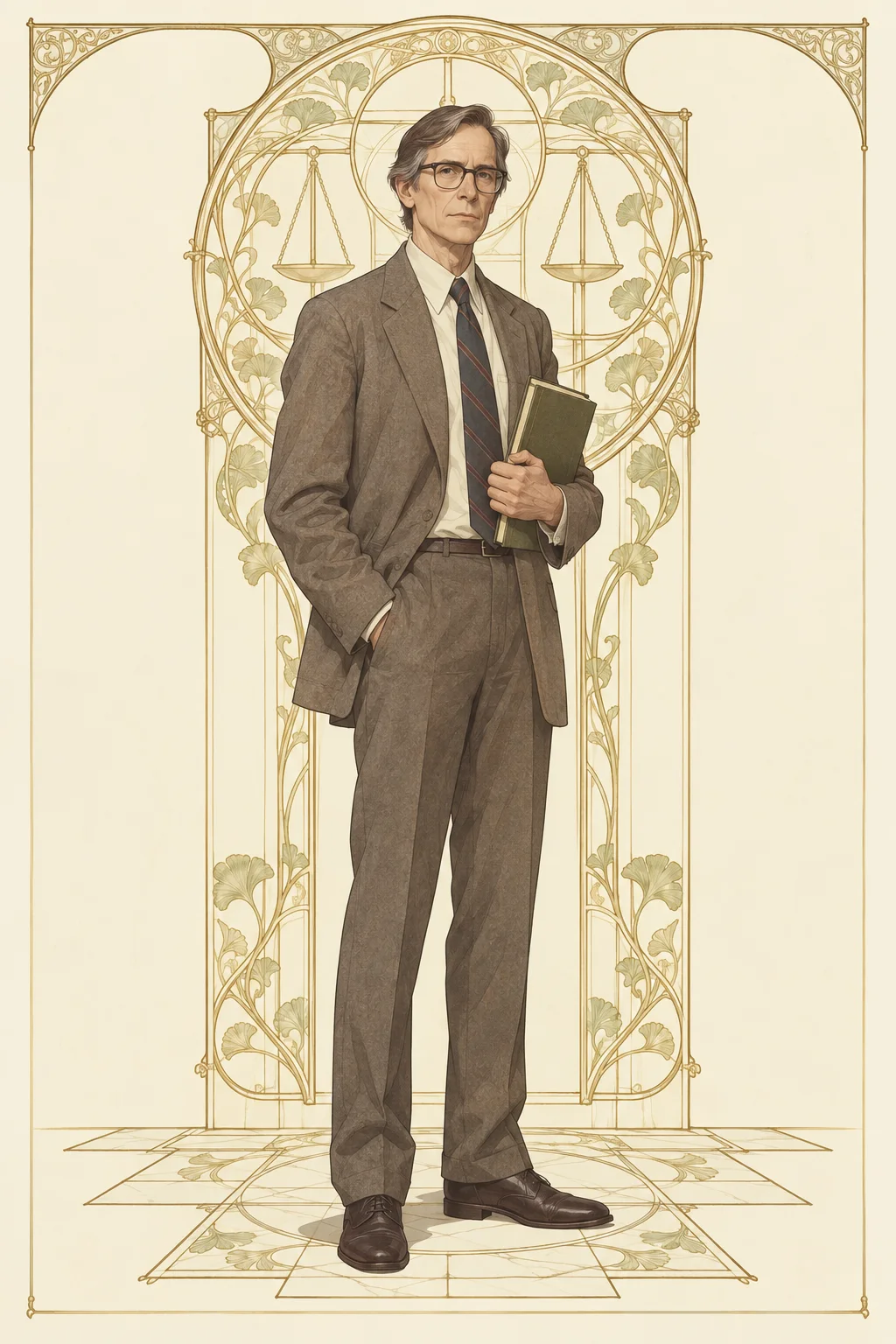
John Rawls
LII-D "Architect" Political Philosopher · American · 20th c.American political philosopher (1921–2002). In A Theory of Justice (1971) he used the "veil of ignorance" thought experiment to argue that "a society giving maximum consideration to the most disadvantaged position is the most just." The most influential Anglo-American philosopher of the 20th century.
Leading Function+Ti-p(組織と法律)
"The veil of ignorance" — design institutions without knowing your birth position. The "difference principle" — the most disadvantaged deserves maximum consideration.
Creative Function-Ne-c(良識と平和)
"The method of avoidance" — not claiming which side is true regarding conflicting values. "Overlapping consensus" — trusting voluntary agreement.
Vulnerable Function 1+Se-p弱(偉業と庇護)
Weak +Se-p: declining all offers to enter politics — "that's not for me." Discussing Vietnam opposition as an institutional argument rather than street protest.
Vulnerable Function 2-Fi-c弱(本心と和解)
Weak -Fi-c: wife Margaret's testimony: "He almost never spoke about his own feelings." Declining nearly all public honours.
Quadra / Temperament / Club
Quadra: Anti-Gamma Quadra (Utopia) — "A just society is actually possible" — optimistic trust. "Maximum consideration for the most disadvantaged" — selfless community design.
Temperament: Balanced-Stable temperament: refining the theory over 50 years at his own pace without being swept by turbulent times.
Club: Researcher Club: intellectual system-building through papers, discussions, and seminars at Harvard for half a century.
Worldview & Attitude
"The unjust institutions that disadvantage the least well-off exist" — the direct statement of present reality. The ないもの (a perfectly just society) is not proclaimed.
Attitude toward Change: A symbol of hope pointing the direction of justice theory — practical policy change left to political practitioners.
