
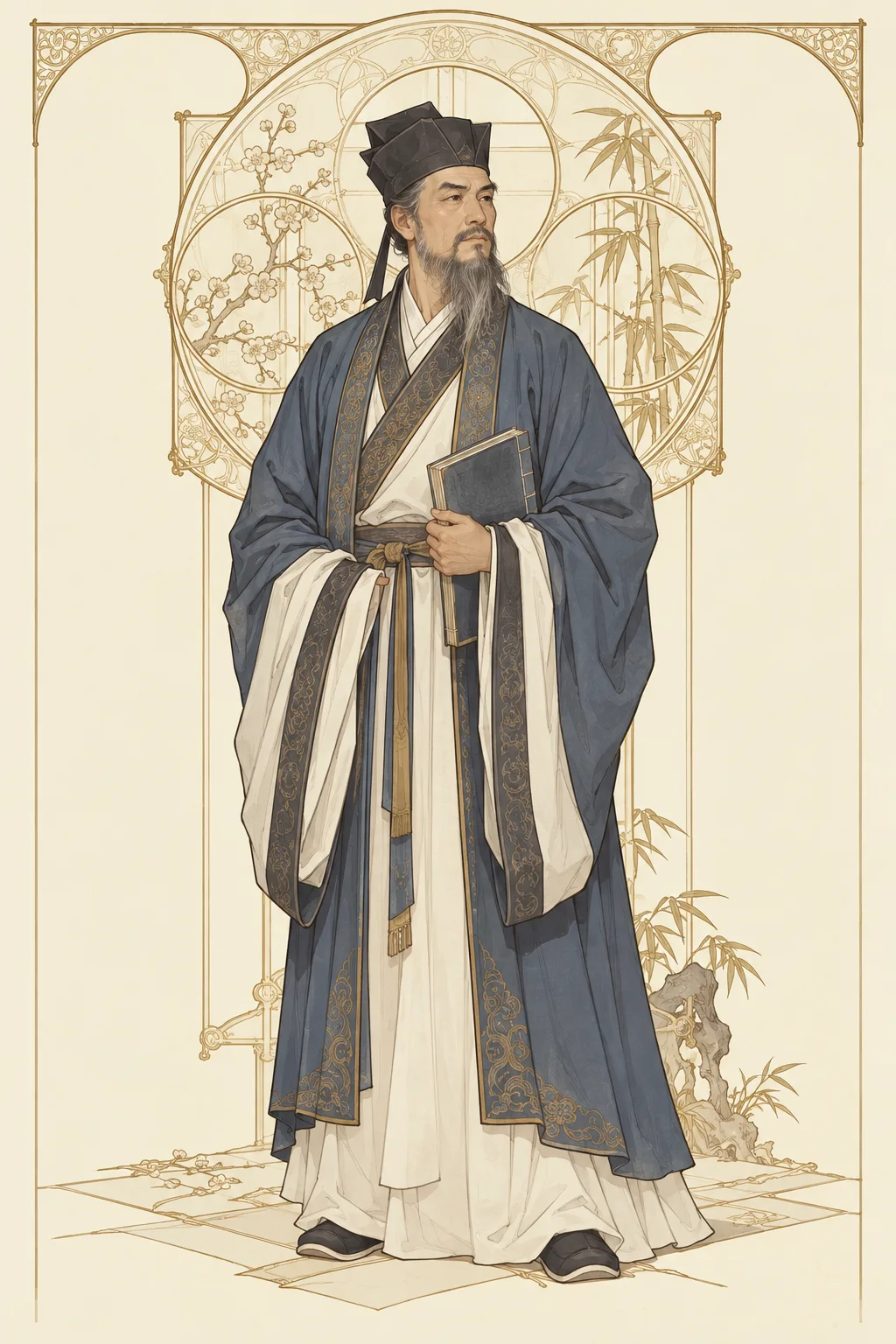
Zhu Xi

LII-D "Architect" Confucian Philosopher · Chinese · 12th c.

Song dynasty Confucian philosopher (1130–1200). He founded "Neo-Confucianism," synthesising the Four Books through "li (principle)" and "qi (vital force)." His annotations became the imperial examination standard for approximately 600 years across East Asia.

Leading Function+Ti-p(組織と法律)

Precise annotation and compilation of the Four Books — the final systematisation of Confucian communal ethics. These annotations served as the imperial examination standard for ~600 years from 1313 to 1905.

Creative Function-Ne-c(良識と平和)

"Jing (reverence)" practice — placing "a careful and gentle introspective attitude" at the core of character formation. "Gewu zhizhi" — the quiet intellectual ordering of exploring the principle of things.

Vulnerable Function 1+Se-p弱(偉業と庇護)

Weak +Se-p: spending his life in the private sphere except for 46 days at court — consistently avoiding power. Responding to political suppression with silence and retreat.

Vulnerable Function 2-Fi-c弱(本心と和解)

Weak -Fi-c: prioritising "investigation of principle" over personal emotion. In philosophical debates with Lu Jiuyuan, only systematic logical responses.

Quadra / Temperament / Club

Quadra: Anti-Gamma Quadra (Utopia) — "Love people, benefit things" — contribution to the community at the ethical centre. Social granary as the same Quadra cooperative institution.

Temperament: Balanced-Stable temperament: annotations functioning for 600 years. Refusing officialdom for decades, completing the system at his own pace.

Club: Researcher Club: operating an intellectual community centred on the academy — the archetypal Researcher Club. Dialogic scholarship through conversations with disciples.

Worldview & Attitude

"The corruption of scholarship and moral failures of officialdom exist" — the direct statement of present reality. The ないもの (a world of perfect moral governance) is not proclaimed.

Attitude toward Change: Pointing the direction of Neo-Confucianism as transformation — annotations recognised and applied for 600 years after death.