
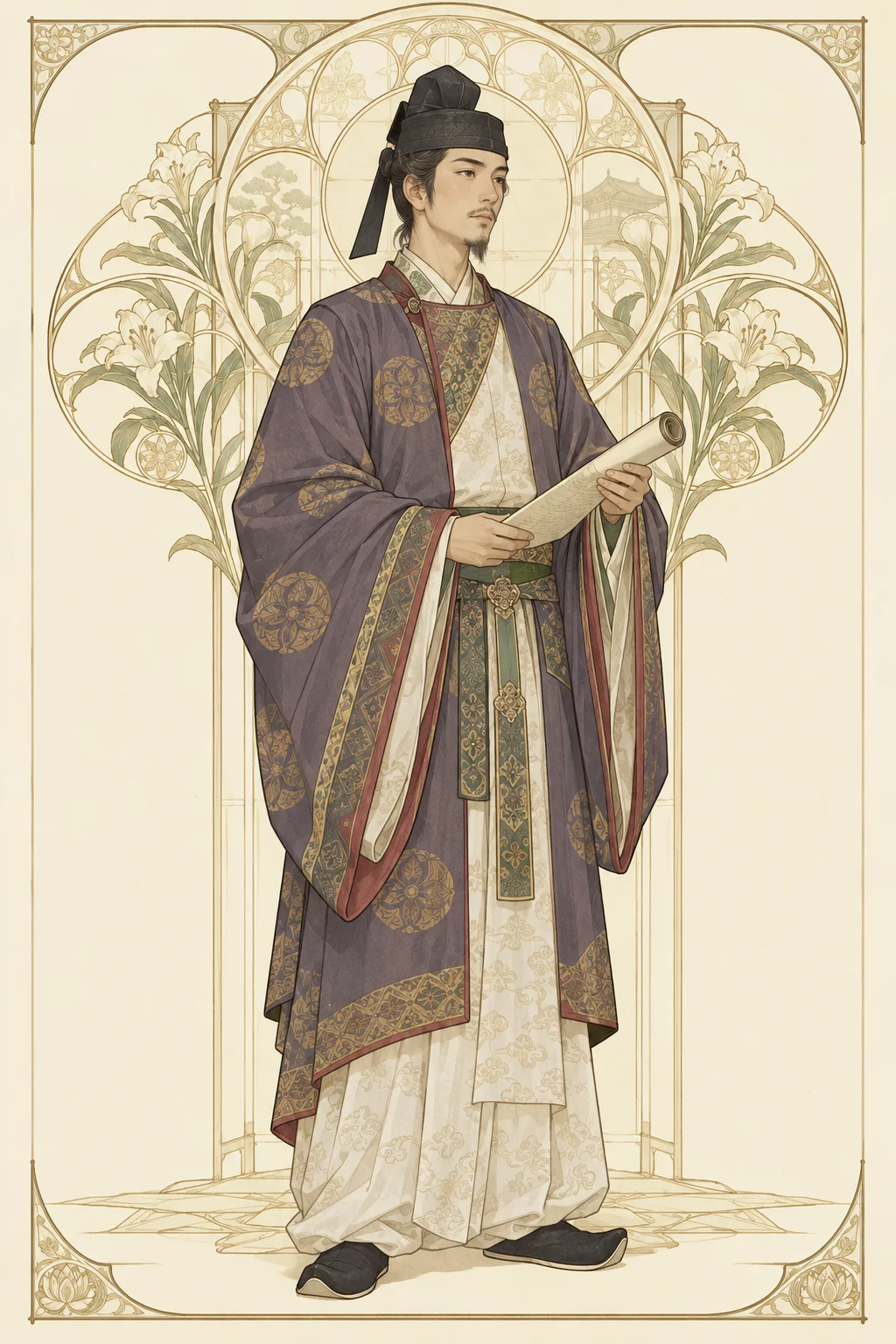
Prince Shōtoku (Umayado)
LII-D "Architect" Statesman · Japanese · 6th–7th c.Asuka period statesman (574–622). As regent to Empress Suiko, he established the Seventeen-Article Constitution and twelve-level cap rank system. Based on Buddhism and Confucianism, he promoted governance by ethics. A legendary figure of Japanese institutional imagination.
Leading Function+Ti-p(組織と法律)
"Seventeen-Article Constitution (604)" — Japan's first written legal code. Article One: "Harmony is to be valued; resist not others arbitrarily" — placing the wisdom of conflict avoidance as the first principle of national design.
Creative Function-Ne-c(良識と平和)
"Harmony is to be valued" — not merely a slogan, but the systematic "institutionalisation of the field's implicit direction" to prevent conflict. Article Ten: "Suppress anger, abandon wrath."
Vulnerable Function 1+Se-p弱(偉業と庇護)
Weak +Se-p: carefully maintaining the relationship with the Soga clan while avoiding direct confrontation — typical passive response.
Vulnerable Function 2-Fi-c弱(本心と和解)
Weak -Fi-c: almost no records of personal emotional expression. "Harmony" keeps his own emotions outside the institutional framework.
Quadra / Temperament / Club
Quadra: Anti-Gamma Quadra (Utopia) — Buddhist equality — placing "compassion for all living beings" as the ethical foundation of the national institution.
Temperament: Balanced-Stable temperament: institutional reform spanning decades — "building the foundation" rather than "changing immediately."
Club: Researcher Club: three-sutra commentary as Researcher Club-type scholarly works. International research network through the envoys to Sui China.
Worldview & Attitude
"The disorder and factional strife of the Yamato court exist" — the direct statement of present reality. The ないもの (a harmonious realm) is not proclaimed.
Attitude toward Change: Executing the Seventeen-Article Constitution as a realistic transformation plan — a practitioner of failure-resistant staged state-building.
