
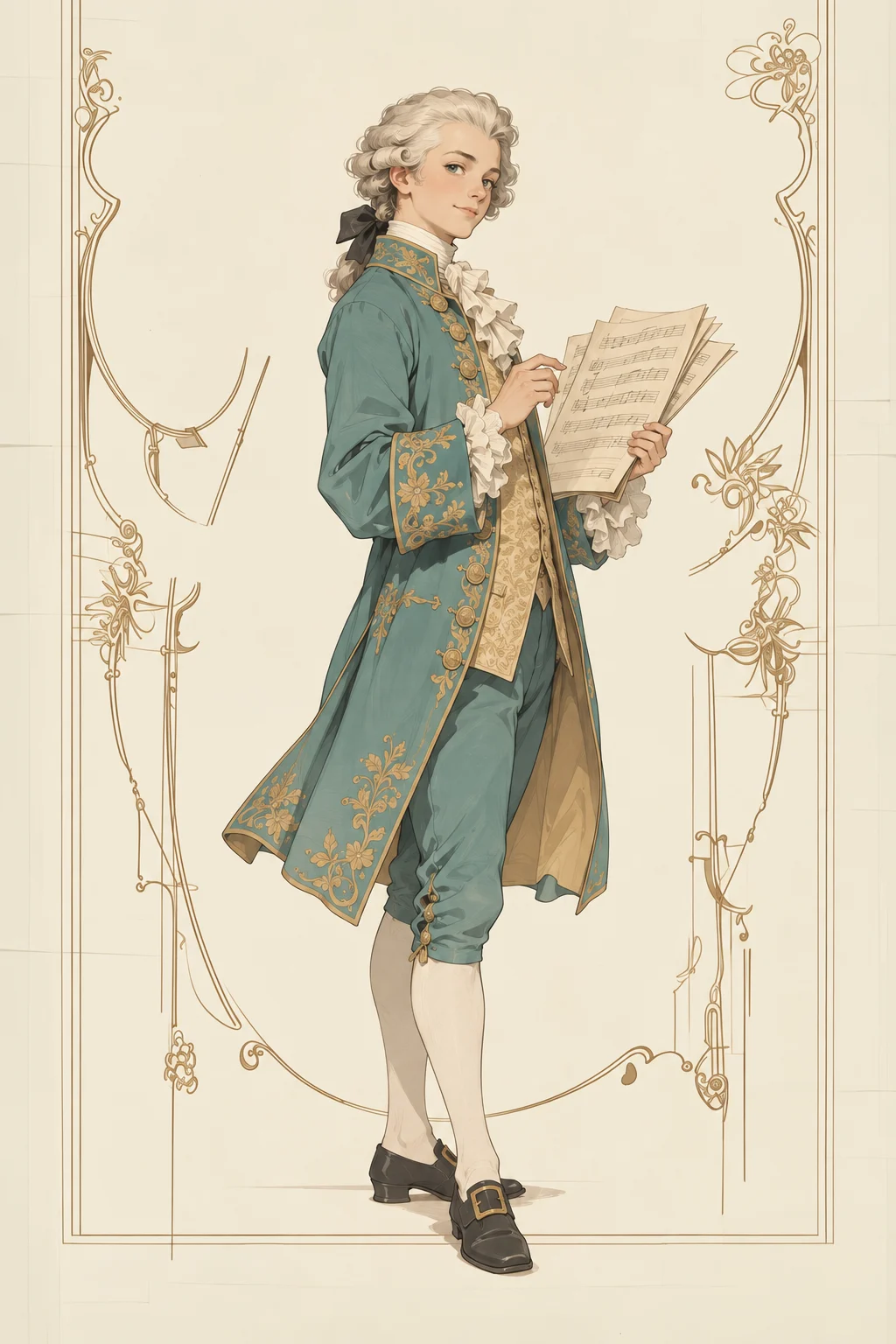
Wolfgang Amadeus Mozart
SEI-D "Peacemaker" Composer · Austrian · 18th c.18th-century Austrian composer. A genius who composed over 600 works in a 35-year life. He reached the apex of classical music with The Marriage of Figaro, Don Giovanni, and The Magic Flute. Renowned as a prodigy from childhood, he served as a court musician while leaving humanity its greatest musical legacy.
Leading Function+Si-p (Comfort & Wellbeing)
Obsessive attachment to food, sensory pleasures, and comfortable surroundings — repeatedly recorded in letters — is the core of +Si-p action. Insistence on lavish Viennese lodgings, indulgence in fine food, and detailed attention to clothing appear frequently in family correspondence.
Creative Function-Fe-c (Harmony & Emotion)
Cheerful disposition with a deep aversion to conflict — quietly dissolving tension through humor before scenes escalate — is the core of -Fe-c action. Softening the charged atmosphere of concerts and converting court tensions into laughter: recorded by multiple contemporaries.
Vulnerable Function 1+Te-p weak (Practicality & Economy)
Weak +Te-p (Practicality & Economy): squandering enormous income and remaining in debt throughout his life with virtually no grasp of finances. Despite vast earnings from performances and compositions, a record of continuous financial ruin persists. Practical financial management was consistently delegated to others.
Vulnerable Function 2-Ni-c weak (Warning & Divergence)
Weak -Ni-c (Warning & Divergence): repeated misjudgments at pivotal junctures — court standing, patron relationships. Missteps in the clash with Archbishop Colloredo of Salzburg, misreading the relationship with Joseph II — a pattern of poor branching decisions at critical turning points.
Quadra / Temperament / Club
Quadra: Alpha Quadra (Genesis) — beauty, sensory joy, intellectual play, and warmth co-exist at the core of his work, reflecting Alpha values. Within the existing courtly order, maximising personal sensory pleasure and intellectual curiosity defines an Alpha Quadra style of democratic musical openness.
Temperament: Receptive-Adaptive temperament: going with the flow rather than resisting patrons, court politics, or compositional demands. Moving from Salzburg court to Vienna freelance, the style adapted entirely to each context without hardening into a fixed posture.
Club: Socialite Club: placing human relationships at the centre of creative work. Court society, salons, and concerts as social fuel for composition. Dense correspondence with father and sister as the maintenance of a social network.
Worldview & Attitude
Pure trust in everyday beauty and sensory joy. Focus on the music of human connection rather than the dangers of the courtly power structure.
Attitude toward Change: Makes no attempt to lead transformation; leaves it to the era to discover and re-evaluate his legacy. Musical inheritance as a form of patient waiting — the Romantics discovered him posthumously.
