
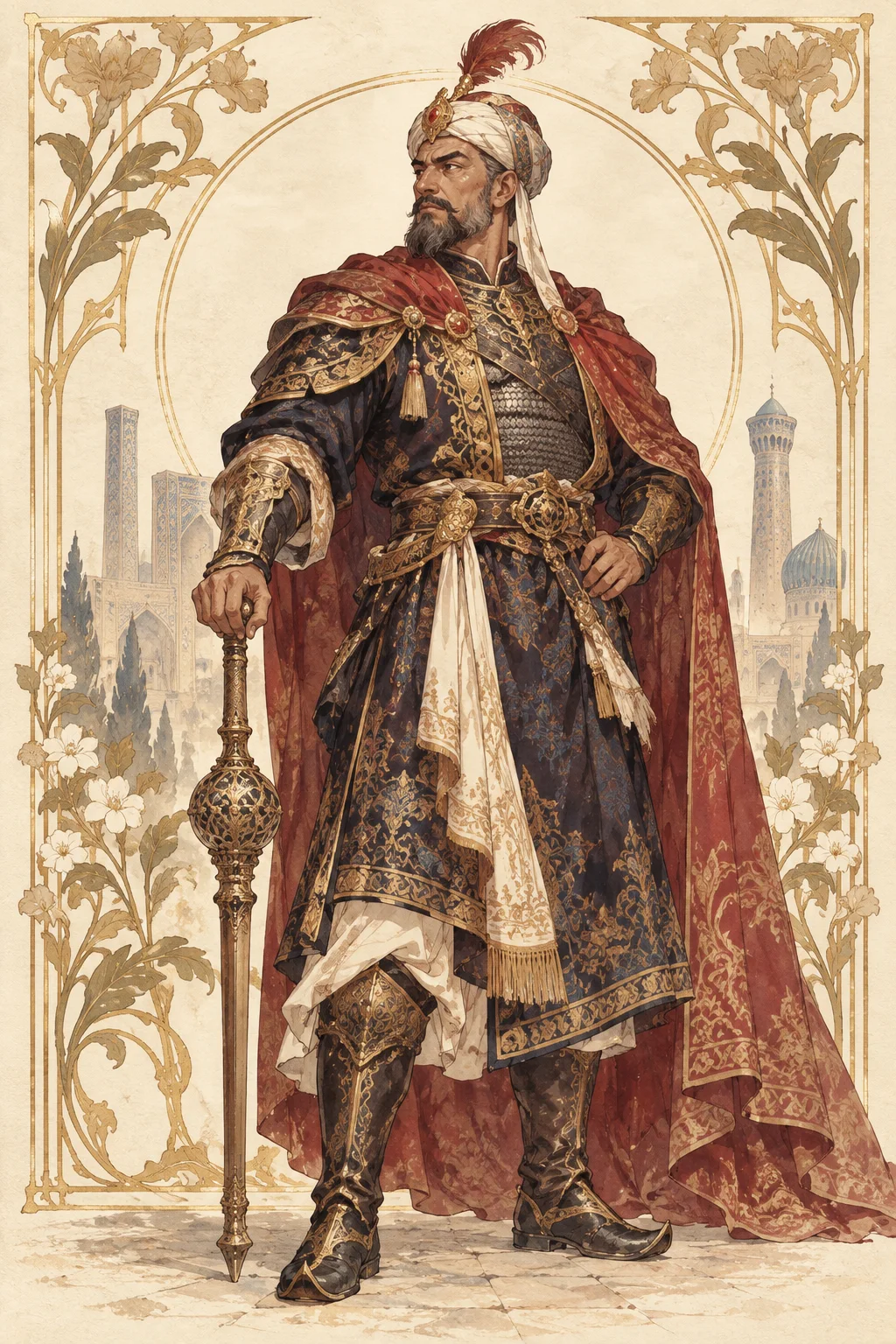
Timur (Tamerlane)
SLE-D "Conqueror" Conqueror · Timurid · 14th–15th c.Founder of the Timurid Empire (1336–1405). Claiming succession from Genghis Khan, he conquered Central Asia, Persia, India, and Anatolia. The sack of Delhi and the Battle of Ankara defeating Bayezid I were his peak achievements. His capital Samarkand became a centre of Islamic cultural splendour. Like Genghis, his empire fragmented almost immediately after his death — conquest without institutional durability.
Leading Function-Se-p (Victory & Dominance)
"The world is not wide enough for two kings" — conquest as the meaning of existence. Treating surrendering cities with generosity; systematically massacring resistant ones — slaughtering 100,000–200,000 after Isfahan's revolt.
Creative Function+Ti-c (Precision & Thoroughness)
Dividing territories into Tümen (10,000-troop support areas); selecting officials by loyalty and ability. "Strategic precision pushed to the extreme" — outmanoeuvring Bayezid I (Ottoman) and Toqtamish simultaneously.
Vulnerable Function 1-Fi-p weak (Compassion & Consideration)
Weak -Fi-p: attacking and defeating ally Toqtamish the moment he judged him as "a traitor." Killing brother-in-law Husayn and taking his wife. "Personal loyalty and friendship are not calculated" — only benefit and dominance judge.
Vulnerable Function 2+Ne-c weak (Hypothesis & Imagination)
Weak +Ne-c: the empire fragmenting almost immediately after his death — failing to solve the succession problem. Overwhelming strength at "conquering" but weak at "long-term design after conquest."
Quadra / Temperament / Club
Quadra: Beta Quadra (Empire) — "the sword of Islam," "successor to Genghis Khan" as the intense yearning for historical mission. Religion used as "a tool of power" rather than as sincere faith.
Temperament: Flexible-Maneuvering temperament: betraying ally Toqtamish, using religion as a tool, immediately absorbing conquered peoples' technologies and personnel. "When the situation changes, strategy changes" — no fixed ideological position.
Club: Pragmatist Club — collecting art and culture "for the prestige of the capital Samarkand" while personally concentrating on "managing the organisation of conquest." "Supply, personnel, intelligence" as practical management.
Worldview & Attitude
"The rule of the strong creates order" — a worldview of structural danger where only military force establishes legitimate authority.
Attitude toward Change: Executing Central Asian conquest as a realistic plan — the greatest nomadic empire-builder after Genghis Khan, but leaving no institutional legacy.
